Science Fiction
Best Sci-Fi Audiobooks of 2026
What makes a great sci-fi audiobook
Sci-fi asks more of a narrator than most genres. The vocabulary is technical, the worldbuilding is dense, and the cast of characters can span factions, planets, centuries, and species, sometimes within the same chapter. A narrator who stumbles on invented terminology pulls you out of the world instantly. One who plays all the alien POVs at the same register makes the novel's scale collapse. And one who treats the science as something to get through, rather than something to inhabit, loses the whole genre's emotional argument.
Three things separate great sci-fi narrators from capable ones. The first is technical fluency: vocabulary like terraforming, epigenetic lock, and praxis has to land as natural speech, not careful pronunciation. Ray Porter's physics in Project Hail Mary doesn't sound like a textbook being read. It sounds like a scientist under pressure thinking out loud. The difference is audible within the first ten minutes.
The second is character differentiation at scale. Hard science fiction routinely spans factions with different ideologies, dialects, and social textures. Jefferson Mays narrating nine Expanse novels across Earth, Mars, and the Asteroid Belt is the masterclass. The Belter creole, Martian-clipped, and Earth-standard registers hold consistent from book one through the finale, a continuity achievement that makes the series cohere as a single listening experience rather than nine separate ones.
The third quality is harder to name but the easiest to hear: the best sci-fi narrators find the human stakes inside the technical premise. Wil Wheaton's Watney isn't funny because Wheaton is a funny narrator. He's funny because he's playing a man who has chosen humor as his primary cognitive defense against panic. Kevin R. Free's Murderbot isn't flat because Free has a flat delivery. The flatness is armor, and the moments it cracks are the moments the character becomes real. Jeff Woodman doesn't play for sympathy in Flowers for Algernon. He plays for precision. That's what makes it devastating.
The picks below were chosen for the voice first. Story quality matters: nothing here is narratively weak. But the audiobook performance had to earn its place independently of the book's critical reputation or popularity. The result spans the full range of the genre, from hard sci-fi and space opera to satirical comedy, posthuman, and literary science fiction.
All 10 picks at a glance
| # | Title | Author | Narrator | Runtime | Listen |
|---|---|---|---|---|---|
| 1 | Project Hail Mary | Andy Weir | Ray Porter | 16h 10m | Listen → |
| 2 | Leviathan Wakes | James S.A. Corey | Jefferson Mays | 20h 56m | Listen → |
| 3 | Red Rising | Pierce Brown | Tim Gerard Reynolds | 16h 12m | Listen → |
| 4 | Dune | Frank Herbert | Scott Brick & full cast | 21h 2m | Listen → |
| 5 | The Martian | Andy Weir | Wil Wheaton | 10h 59m | Listen → |
| 6 | The Hitchhiker's Guide to the Galaxy | Douglas Adams | Stephen Fry | 5h 51m | Listen → |
| 7 | All Systems Red | Martha Wells | Kevin R. Free | 3h 17m | Listen → |
| 8 | Recursion | Blake Crouch | Jon Lindstrom & Abby Craden | 10h 47m | Listen → |
| 9 | Children of Time | Adrian Tchaikovsky | Mel Hudson | 16h 31m | Listen → |
| 10 | Flowers for Algernon | Daniel Keyes | Jeff Woodman | 8h 58m | Listen → |
The picks · 1–10
Ten, ranked editorially.
Ordering is editorial, not algorithmic. We argued.
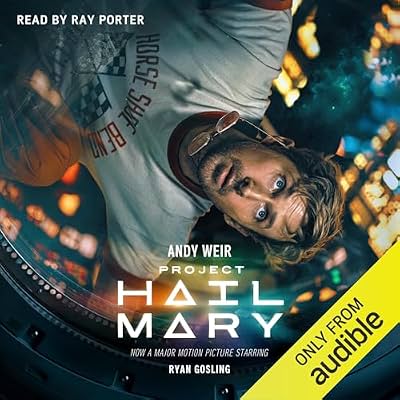
Project Hail Mary
Best for converting someone who says they "don't listen to audiobooks."
Andy Weir's lone-survivor-on-a-mission premise gives Porter a single POV to develop across 16 hours, and the result is the most intimate performance in science fiction audiobooks. The science sequences don't slow the pacing because Porter treats them the way Ryland Grace would: as thinking aloud under pressure, not as lectures to be delivered. When Rocky arrives, Porter renders an alien consciousness that feels genuinely other while still communicating everything Grace needs to understand about it.
This is the audiobook that most often converts people who didn't think of themselves as audiobook listeners. The reasons are entirely in the performance.
Porter records cold, meaning he doesn't know where the story is going when he performs it. His genuine surprise at the Rocky reveals mirrors the listener's. There's a warmth in his Ryland Grace that never tips into sentimentality, and the humor lands exactly where Weir intended because Porter understands the character's relationship to it. The performance that defines the genre right now.
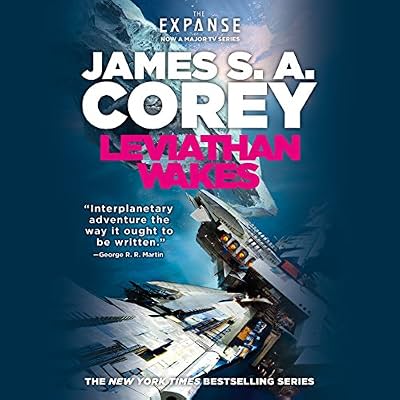
Leviathan Wakes
Best for committing to a nine-book series and never looking back.
James S.A. Corey's nine-book Expanse series begins here, on a solar system where Earth, Mars, and the Asteroid Belt have developed distinct cultures and, critically, distinct accents. The dual-POV structure gives Mays Holden's idealistic tenacity and Miller's eroded cynicism to carry simultaneously, and he handles them as two fully realized performances rather than one performance modulated up or down.
The commitment required to start a nine-book series is real. The reason Expanse listeners tend to finish it is also real, and it starts here.
Mays performs dozens of distinct characters across nine books without a voice drifting. The Belter creole, Earth-standard, and Martian-clipped registers hold consistent from book one through the finale, a continuity achievement that makes the series cohere as a single listening experience. By book three, you won't be able to imagine anyone else in the role.

Red Rising
Best for the listener who wants the narrator to do real lifting.
Pierce Brown's dystopian sci-fi trilogy is structured as a class war dressed in the mythology of ancient Rome. Darrow, born into the lowest caste of a rigidly stratified society, is surgically altered to infiltrate the ruling class and destroy it from within. The premise requires Reynolds to voice a character performing a character, and the layers don't collapse.
The audiobook fanbase for Red Rising tends to be more fervent than its print counterpart. The reason is almost entirely Reynolds.
Reynolds gives Darrow a voice that makes the class rage feel personal, not performed. Across six books he sustains a cast of dozens without a single character blurring into another. His performance of the second book's final act is the most-cited single listening experience among the readers who've encountered it. The rare series where the narrator became as essential as the author.

Dune
Best for hearing how dense political sci-fi can actually flow.
Herbert's 1965 epic is dense with invented terminology, layered political intrigue, and philosophical asides that stop the narrative cold if mishandled. The Macmillan Audio full-cast production assigns individual narrators to each POV character, a solution that makes the novel's shifting alliances audible rather than abstract. The competing faction loyalties that require a mental diagram on the page become distinct across twelve performers.
This production is the reason the full-cast format became the standard recommendation for dense science fiction. The benchmark for ensemble sci-fi production.
Scott Brick handles Paul's chapters with the specificity of someone who has read every Herbert annotation: the voice ages credibly across the narrative arc. Simon Vance's Baron Harkonnen is theatrical without excess. The production's decision to give each Great House a distinct vocal texture is what makes the political complexity navigable across 21 hours without losing the thread.

The Martian
Best for a long drive when the laughs need to feel earned.
Mark Watney is stranded alone on Mars after a mission abort leaves him for dead. The novel is written almost entirely as Watney's mission log, making it one of the most demanding single-narrator performances in the genre: one voice processing impossible circumstances through sustained, genuinely funny dry humor. The book lives or dies on whether the humor lands, and whether you believe the man behind it.
Wheaton's Watney is funny the way a person under genuine pressure is funny. That distinction is the whole performance.
Wheaton doesn't play Watney as a comedian performing jokes. He plays a scientist who has chosen humor as his primary cognitive defense against panic. A performance pitched a fraction higher in the comedy register would make Watney annoying; a fraction lower would undercut the wit. Wheaton calibrates it exactly. Note: Wheaton narrates this edition, not the earlier recording.
Comparison lists
If you loved…
Start from a book you know. Each list is built around what made the original great as an audiobook, not just as a story.
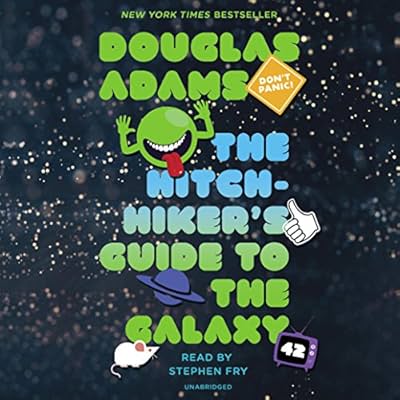
The Hitchhiker's Guide to the Galaxy
Best for a six-hour palate cleanser between heavier books.
Douglas Adams's satirical universe (Earth demolished to make way for a hyperspace bypass, a depressed robot, the answer to life, the universe, and everything) is one of the most voice-dependent texts in the canon. The Guide's internal contradictions and parenthetical observations read as dry on the page and come alive only when delivered with the right comic timing. This is one of the rare cases where the reader's relationship with a novel fully depends on the performer they encounter first.
The 5h 51m runtime makes this the lowest-commitment entry point on the list for a first listen.
Fry's timing is so precisely matched to Adams's rhythms that it sounds like authorial intent. The Vogon poetry, Marvin's theatrical despair, the Guide's self-referential asides: each lands because Fry understands that the humor requires understatement, not performance. A fraction more energy in any direction would tip it into parody. He holds the line through all five books.

All Systems Red
Best for testing whether a series is for you in one afternoon.
Martha Wells's Murderbot Diaries begins here: a self-described construct with 25% human DNA who has hacked its own governor module and now spends its downtime watching serialized drama while reluctantly being responsible for a group of scientists it has grown attached to. The first-person narration is the novel's entire texture. Murderbot's flat affect and social anxiety are simultaneously the comedy, the horror, and the emotional core.
The novella format means you can test the premise in an afternoon before committing to the series. Most people commit to the series.
Free performs Murderbot's flatness as armor, not affect. The construct's discomfort with human interaction reads as deeply recognizable social anxiety, and when that armor cracks, when Murderbot admits it cares, it lands because Free has held the register steady long enough that any deviation means something. At 3h 17m, the novella format actually helps: the constraint forces every line to count.

Recursion
Best for hearing dual-narrator casting that pays off the gimmick.
Blake Crouch's time-loop thriller follows two alternating protagonists: Barry Sutton, a New York detective encountering a phenomenon he doesn't yet understand, and Helena Smith, a neuroscientist building the technology at the center of it. The structure demands each narrator carry a distinct emotional register while both arcs converge toward the same breaking point. The novel's architecture is designed to deliver a specific kind of final-act impact, and it only lands if the dual-narrator casting works.
Lindstrom gives Barry the weariness of a detective who has encountered things he can't explain. Craden gives Helena the precision of someone who understands exactly what she's built and is only now reckoning with it. The dual-narrator structure pays off in the final act: hearing two different voices arrive at the same moment from opposite directions makes the ending land differently than a single narrator could allow. Casting as storytelling device.

Children of Time
Best for the skeptic who thinks they can't care about spiders.
Adrian Tchaikovsky's hard sci-fi requires a narrator to give a point of view to uplifted spiders developing civilization across millennia. The Portia chapters aren't from a human perspective at all: the consciousness, the social structure, the very concept of selfhood differs from anything in the human sections. The risk in this novel is condescension, either toward the alien sections or the human ones, and neither is acceptable.
The novel's argument only lands if the listener believes in both civilizations equally. Hudson makes that possible.
Hudson treats the Portia chapters with the same emotional weight as the human ones, which is exactly right. She holds the two lines at parity throughout the novel's considerable length, and the cumulative effect is one of the most technically demanding performances in science fiction. If you're coming to this from the skeptical angle, start listening. The premise resolves into something else entirely.

Flowers for Algernon
Best for hearing what narrator craft looks like at its absolute limit.
Daniel Keyes's 1966 novel follows Charlie Gordon, a man with an intellectual disability who undergoes experimental surgery to dramatically raise his intelligence, then watches the process reverse. The entire text is written as Charlie's progress reports, and the prose shifts from phonetic misspellings through sophisticated philosophical reflection and back again. No other pick on this list demands as much range from a single narrator, and no other pick makes the narrator's craft as audibly visible.
The less-obvious pick on this list and the one with the strongest narrator argument of all ten.
Woodman performs the full arc without a false note. The early sections are halting and warm without condescension. The peak-intelligence passages are articulate without coldness. The regression doesn't reach for sympathy: it reaches for precision, which is what makes it devastating. If you want to hear what narrator craft looks like operating at its limit, this is the recording to study.
Curated lists
Browse sci-fi by
Every list ranked by narration quality, not review score.
Where the voice is the whole point.
Different ways into the genre depending on how you listen.
Where you want to start in the genre's history.
The full narrator-performance ranking: Best Sci-Fi Audiobooks for Narrator Performance (9 picks) →
Narrators who define the genre
Three voices worth following across everything they've recorded
Ray Porter
Hard sci-fi · Humor under pressure
The most-cited reason people discover audiobooks. Project Hail Mary made him a household name, but We Are Legion, The Fold, and Outland show the same quality across very different material. His specialty is warmth that never tips into sentimentality: you believe every character cares about what they're doing.
Read the full spotlight →Jefferson Mays
Space opera · Political sci-fi
Nine Expanse novels, dozens of distinct characters, zero voices drifting across thousands of recorded hours. The Belter creole and Martian-clipped accents he established in book one are still exact in book nine. The technical continuity achievement of modern science fiction audiobooks.
Tim Gerard Reynolds
Military sci-fi · Dystopian
Red Rising's class rage sounds personal because Reynolds performs it that way. Six books, a cast of dozens, the character voices consistent enough that returning to an earlier book after finishing the series feels like visiting people you remember clearly. The rare narrator who became essential to a franchise's reputation.
Adjacent shelves
If sci-fi is the starting point
Genre boundaries are editorial fictions. These overlap more than they diverge.
Frequently asked questions
Questions about sci-fi audiobooks
What's the best sci-fi audiobook for someone new to the genre?
Project Hail Mary, narrated by Ray Porter. It's the most-cited entry point for people who've never thought of themselves as audiobook listeners. The science is explained through character rather than exposition, and Porter's performance is warm enough that the 16-hour runtime feels short. Start there.
Are these available on Spotify or Apple Books?
Most are on multiple platforms. All ten are on Audible. Most are also available through Libro.fm if you prefer to support an independent bookstore. Availability varies by title and region. Confirm at point of purchase.
What's the shortest pick on this list?
All Systems Red by Martha Wells, narrated by Kevin R. Free, runs 3 hours 17 minutes. The Hitchhiker's Guide to the Galaxy, narrated by Stephen Fry, is 5 hours 51 minutes. Both are strong entry points if you want to test a narrator before committing to a longer series.
Is Dune worth listening to as an audiobook?
Yes. The Macmillan Audio full-cast production is arguably the best way to experience the novel's political complexity. Herbert's original is dense on the page. The full-cast format makes the competing faction loyalties audible rather than requiring you to maintain a mental diagram. Scott Brick's Paul and Simon Vance's Baron Harkonnen are both definitive performances. Start with book one.
What makes a great sci-fi narrator?
Three things: technical fluency with the genre's invented vocabulary; character differentiation across large casts spanning factions, planets, or centuries; and the ability to find the human stakes inside a technical premise. A narrator who stumbles on terminology or plays all alien POVs at the same register makes the worldbuilding collapse. The best sci-fi narrators make the invented world real in a way the page alone can't always achieve.
New to Audible? Start your free 30-day trial →
How we picked
Selection criteria
Picks were evaluated on narration first: technical fluency with the genre's vocabulary, character differentiation across large casts, and the capacity to find the human stakes inside a technical premise. Story quality was a secondary criterion. Nothing here is narratively weak, but the audiobook performance had to earn its place independently of the book's critical reception or sales rank.
Narrator credits are verified against current Audible editions. Where multiple editions exist, the most significant current production is cited. Affiliate links are to Audible. Most titles are also available through Libro.fm and other platforms. The list is reviewed annually; individual picks are replaced when a better-narrated alternative emerges or when a cited edition is discontinued.