Sci-Fi
Audiobooks Like Project Hail Mary

If Ray Porter making orbital mechanics feel like the most exciting thing in the universe, and Rocky feel like a friend, is what hooked you, this list starts there.
What makes Project Hail Mary work: a single mind alone in deep space, solving impossible problems with more delight than dread, science-wonder that treats curiosity as its own reward, and the solo-voice intimacy of a first-person narrator you would follow anywhere. Every pick on this list shares at least one.
All 10 picks at a glance
| # | Title | Author | Narrator | Runtime | Listen |
|---|---|---|---|---|---|
| 1 | We Are Legion (We Are Bob) | Dennis E. Taylor | Ray Porter | 9h 56m | Listen → |
| 2 | All Systems Red | Martha Wells | Kevin R. Free | 3h 17m | Listen → |
| 3 | Contact | Carl Sagan | Laurel Lefkow | 14h 45m | Listen → |
| 4 | The Martian | Andy Weir | Wil Wheaton | 10h 59m | Listen → |
| 5 | Leviathan Wakes | James S.A. Corey | Jefferson Mays | 20h 56m | Listen → |
| 6 | Ender's Game | Orson Scott Card | Stefan Rudnicki, Harlan Ellison | 11h 19m | Listen → |
| 7 | Seveneves | Neal Stephenson | Mary Robinette Kowal, Will Damron | 31h 55m | Listen → |
| 8 | Recursion | Blake Crouch | Jon Lindstrom, Abby Craden | 10h 47m | Listen → |
| 9 | Children of Time | Adrian Tchaikovsky | Mel Hudson | 16h 31m | Listen → |
| 10 | Remnant Population | Elizabeth Moon | Suzanne Toren | 12h 18m | Listen → |
What Project Hail Mary listeners come back for
Ray Porter's performance is why Project Hail Mary became an audiobook event rather than just a bestseller. His Ryland Grace makes orbital mechanics feel like the most exciting thing in the universe, and his Rocky is something rarer: an alien that is genuinely alien, communicating through sound and physics and growing warmth, without ever tipping into comedy or sentiment it hasn't earned. The wit is always Porter's. The warmth is always the character's. That distinction is harder to hold than it sounds, and he holds it for sixteen hours.
Every pick below was scored against Project Hail Mary's defining qualities: the solo-voice intimacy of a single mind working a hard problem, the science-wonder that treats curiosity as its own reward, and the specific pleasure of feeling like you are in very capable hands. The list runs from closest match to most deliberate departure. Pick 1 puts Porter himself back on the mic, and it earns the top slot on every dimension we score.
The picks · 1–10
Ten, ranked by how close they get to Project Hail Mary.
Order reflects how closely each recording delivers the Project Hail Mary experience, with narration weighted highest in the scoring model.

We Are Legion (We Are Bob)
Best for listeners who want Ray Porter back on the mic and the same solo-mind-in-deep-space delight, dialed a touch more comic.
Why it matches: Porter himself, running the same one-smart-voice-alone-in-space register that made PHM feel like a conversation.
Bob Johansson dies and wakes up as a self-replicating interstellar probe. What follows is the same experiment Project Hail Mary runs: a single scientist alone in deep space, solving impossible problems with more enthusiasm than dread, finding meaning in the work itself. PHM and We Are Bob are running parallel tracks: the joy of watching an intelligent mind encounter the unknown and treat it as an opportunity rather than a threat, all delivered in the same first-person register that makes both books feel like a personal conversation.
Ray Porter voices Bob Johansson with the same warmth he brings to Ryland Grace: a smart person who genuinely enjoys explaining things, never condescending, always pulling you forward. The self-referential humor is dialed up slightly here, but Porter's ability to make technical exposition feel like a gift rather than a lecture is fully intact, and listeners who loved his PHM performance will find the register instantly familiar.

All Systems Red
Best for listeners who loved being inside a smarter-than-everyone voice and don't mind a three-hour hit of it.
Fair warning: this is a three-hour audiobook, not a sixteen-hour one. If you need a comparable commitment, skip to pick three. But if what you loved about PHM was the narrator's voice, specifically the quality of being inside a mind that is quietly smarter than everyone around it and slightly baffled by its own feelings, All Systems Red does exactly that. Murderbot is a security robot on a science survey mission in hostile space. It has hacked its own governor module so it can watch TV dramas. It also has to keep a group of scientists from dying, which it resents, because they keep making it feel things.
Like Ryland Grace, Murderbot solves problems by paying better attention than the situation expects, and the curiosity-as-survival-strategy tone is nearly identical, just sharper, drier, and funnier.
Kevin R. Free plays Murderbot's deadpan interiority perfectly: the flat affect that is clearly performing flatness, the way a non-human voice describes human behavior with just enough precision to be funny. It's a completely different timbre from Ray Porter, but the same essential trick: making the listener fall for a narrator who insists they're not emotionally available.

Contact
Best for listeners who want PHM's exact emotional architecture: one mind, an enormous question, pure curiosity.
Of every title on this list, Contact most closely matches PHM's emotional architecture. A radio astronomer, alone in a very large situation, using her knowledge and conviction to push through institutions, politics, and fear toward something she can barely articulate wanting. The first-contact scenario is the exact secondary match. Ryland Grace figures out what Rocky is and what it means; Ellie Arroway spends a decade figuring out whether to believe what she heard. But more than the plot, it's the tone: pure curiosity, the same awe at scale, the same refusal to make the alien familiar before it's earned that familiarity.
Sagan wrote this in 1985. PHM was published 36 years later. The conversation between the two books is worth having.
Lefkow brings Ellie Arroway's scientific precision and controlled emotion to the performance without ever making her feel cold. The physics sequences land with the same kind of clarity Ray Porter brings to orbital mechanics in PHM, making complexity feel like a gift rather than homework. It's a technically demanding performance of a technically demanding book, and Lefkow clears that bar consistently.

The Martian
Best for listeners who want the same author and nearly the same tone: one person, hostile environment, morale by problem-solving.
The most obvious pick on this list, and the explanation is short: same author, nearly identical tone. One intelligent person alone in a hostile environment keeping morale up through the sheer pleasure of solving things. The Martian's scenario is stranded engineering rather than space survival. Mark Watney isn't navigating an alien encounter, he's fighting physics and food production. But the emotional experience is almost indistinguishable from PHM: log-entry rhythm, curiosity as the primary coping mechanism, the satisfaction of watching someone think their way out of a situation that should be fatal.
Note: the original RC Bray recording is no longer available. This is the current Audible edition, narrated by Wil Wheaton.
Wheaton leans hard into Watney's performative confidence. Where Ray Porter plays Ryland Grace as someone quietly impressed by the universe, Wheaton plays Watney as a guy who has already decided he's going to be fine and just needs to math his way there. The comedy lands differently, but the technical clarity and character commitment are fully present.
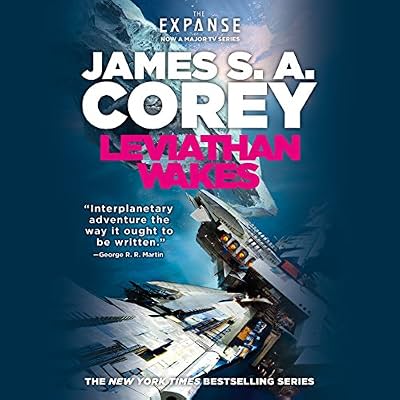
Leviathan Wakes
Best for listeners who loved PHM's scope and want more solar system, more political weight, less warmth.
Space survival is the shared spine: people doing dangerous, difficult things in environments that want to kill them. But where PHM is shot through with warmth and wonder, Leviathan Wakes is colder, more political, and more willing to let its characters make bad decisions with consequences. It's the adult version of the same impulse: you want to understand what's happening in space, and the book rewards that systematically, across a much larger canvas than PHM. The two-protagonist structure, a ship captain who wants to do the right thing and a detective who just wants to find the missing girl, gives Jefferson Mays a wider range to work across than any single-POV narrator gets.
This is the pick for listeners who loved PHM's scope and want more of the solar system, more political texture, more moral weight.
Jefferson Mays makes Holden and Miller genuinely distinct, not through caricature but through posture and rhythm, two ways of being tired in space. He also makes the Expanse's dense worldbuilding feel lived-in rather than expository, which is the specific technical challenge this series required and the reason the early Expanse audiobooks hold up so well.

Ender's Game
Best for listeners who came for the one-brilliant-mind-threading-an-impossible-needle engine and can take a colder, grimmer telling.
Ender's Game and Project Hail Mary are running identical structural engines: both are books about a person who solves problems by thinking better than the situation expects, in an environment built to test them to destruction. PHM's Ryland Grace wakes up not knowing who he is or why he's there; Ender Wiggin is told he's in a training simulation right up to the moment he isn't. The tonal shift is real. Ender's Game is more intense, more grim, and significantly less warm than PHM. But readers who loved the one-brilliant-mind-threading-an-impossible-needle experience will find the same core pleasure here.
This full-cast production distinguishes Ender from his peers through voice rather than description, which matters enormously in a book where so much happens through dialogue and strategy. Stefan Rudnicki provides the gravitas of the anchor narration, and the casting of Harlan Ellison, science fiction's most combative voice doing a cameo as his own character, gives the production a historical footnote worth knowing before you listen.
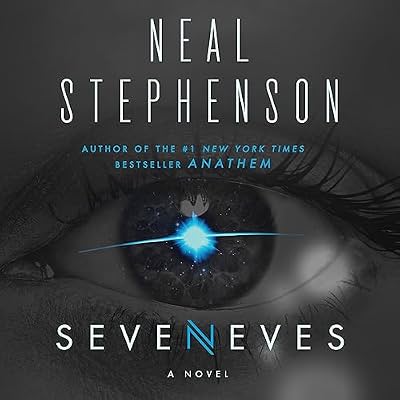
Seveneves
Best for listeners who wanted more of PHM's technical depth and less of its warmth, across 32 unflinching hours.
The moon explodes on page one. What follows is Seveneves asking and answering, over 31 hours and five thousand years, exactly one question: what would it actually take for our species to survive that? The scenario overlap with PHM is exact: space survival and stranded engineering, humanity improvising solutions under existential pressure, and the problem-solving engine is very much present. But where PHM is warm and Weir keeps the wonder intact throughout, Stephenson is meticulous and often cold. This is the pick for readers who wanted more of the technical depth and less of the warmth. Seveneves will reward every hour of the 32 you give it, but it will not be gentle about it.
Mary Robinette Kowal handles the book's multiple POV threads cleanly, with the right register of scientist-in-crisis: precise under pressure, not melodramatic. The dual-narrator format with Will Damron works because both are technically grounded performers rather than actors chasing emotional peaks; in a book this dense, that restraint is the correct choice.

Recursion
Best for listeners who want Weir's science-is-thrilling energy at a higher thriller tempo and lower warmth.
A neuroscientist builds a machine that lets people relive their memories. A detective investigates a psychological epidemic that is rewriting people's pasts. The physics of what the machine actually does, and what it means for the structure of reality, is where Crouch earns his place on a PHM list: Recursion is stranded engineering at its most literal, with a problem-solving engine underneath that keeps escalating what the solution requires. PHM readers who loved the way Weir makes science feel like the most exciting thing in the room will find the same energy here at a higher thriller tempo and considerably lower warmth.
Lindstrom and Craden alternate POV chapters without ever making the hand-off feel mechanical. The structural split between the detective and the scientist actually benefits from having two distinct voices, and both performers play the controlled panic of people who understand exactly how bad things are without ever tipping into melodrama.

Children of Time
Best for listeners who loved Rocky most: an alien mind built from the inside, patiently, until you're rooting for it.
Children of Time is not a survival thriller. If that's what you came for, stop here. Everything above this is more your thing. But if what you actually loved about PHM was Rocky, the specific experience of watching Weir build a mind that has nothing to do with human cognition, communicating through physics and pattern and growing warmth, and finding yourself rooting for it before you realized you were doing it, Children of Time is the only book on this list that does exactly that.
A spider civilization develops across thousands of years of accelerated evolution, consciousness emerging from alien instinct. Tchaikovsky builds that consciousness from the inside with the same patient specificity Weir brought to Rocky's acoustic language. It earns its place on this list for one reason, and that reason is the PHM experience you'd be most likely to miss everywhere else.
Hudson handles the dual structure, alternating between the evolving spider civilization and the desperate human generation ship, with the vocal separation these completely different worlds require. The spider chapters demand a narrator who can sustain wonder without condescension, who can make alien interiority feel coherent without making it feel human. Hudson does it.

Remnant Population
Perfect for listeners who want the Rocky relationship, first contact built on patience and good faith, stretched into a whole quiet novel.
Ofelia is 70 years old when her colony ships leave without her, accidentally abandoned on a planet everyone assumed was empty. It isn't. What follows is a first-contact story built entirely around a single protagonist with no institutional backing, no mission brief, and no particular incentive to be afraid of the unknown. She is too old and too tired for fear. The alien encounter that develops is the quietest, most patient in the genre: not a thriller, not a puzzle-box, just a woman and a species learning each other with patience and good faith. That is the emotional core of Project Hail Mary, the Rocky relationship specifically, stretched into its own full novel.
Suzanne Toren is an AudioFile Golden Voice, the publication's lifetime achievement honor for narrators, with roughly 1,000 recorded titles across a career that predates audiobooks as a mainstream format. Remnant Population is the performance that makes you understand why that kind of tenure matters. Ofelia's particular combination of stubbornness, exhaustion, and open-hearted curiosity is not a register most narrators reach for. It sits between warmth and weariness without collapsing into either. Toren holds it for twelve hours.
About the narrator
Ray Porter and the voice of Project Hail Mary
Ray Porter
PHM's anchor voice · the narrator who made listeners out of readers
Ray Porter has narrated more than 300 audiobooks, but Project Hail Mary is the one that turned him into a household name among people who'd never paid attention to narrators before. His ability to voice Rocky, an alien with no human frame of reference communicating through acoustic vibrations, without it ever tipping into comedy or condescension is the performance that defines his career. The wit is always his. The warmth is always the character's. That distinction is harder to maintain than it sounds, and Porter holds it for sixteen hours without once losing the thread.
Ray Porter narrator spotlightAdjacent shelves
If Project Hail Mary is the starting point
The shelves science-fiction listeners cross over to most often.
Frequently asked questions
FAQ: Audiobooks Like Project Hail Mary
What audiobook is most like Project Hail Mary?
We Are Legion (We Are Bob) by Dennis E. Taylor holds our #1 spot, and the deciding factor is the narrator: Ray Porter reads it too. You get the same solo-scientist-alone-in-deep-space register, the same curiosity-as-coping-mechanism tone, and the same voice that made PHM feel like a personal conversation, just dialed a little more comic.
Do any of these have an alien like Rocky?
Two, and they're the ones to reach for if Rocky is what you loved. Children of Time builds an alien spider consciousness from the inside with the same patient specificity Weir gave Rocky's acoustic language. Remnant Population, our discovery pick, is a first-contact story built entirely on patience and good faith between one person and an unknown species. Both trade the thriller pacing for the relationship.
Is The Martian too obvious to include?
It's the most obvious pick and we kept it anyway, because same author and nearly identical tone is exactly what most PHM listeners want next. One note for the audio: the original RC Bray recording is no longer available, so this is the current Wil Wheaton edition, which plays Watney's confidence a shade broader than Porter plays Grace.
Which pick is best if I loved Ray Porter's narration specifically?
Start with We Are Legion (We Are Bob), which Porter narrates, then keep going: he has recorded more than 300 titles and his catalog runs deep in exactly this kind of first-person science fiction. If it's the voice you came for, that's the fastest path back to it.
New to Audible? Start your free 30-day trial →
How we picked
Selection criteria
We listened to each candidate before deciding. The question driving every pick was whether the recording would satisfy the listener who finished Project Hail Mary and pressed for another. Narration quality was weighted highest in the scoring model. Same-genre matches without a strong performance were cut. Picks 1 through 3 are the closest matches to the seed and rank highest in the default profile. Picks 4 through 9 are strong matches across either scenario or narration, with some variation in tone and warmth.
Pick 10, Remnant Population, is the discovery pick: a quiet 1996 novel the algorithm wouldn't surface for a PHM listener, included to broaden the listening map without breaking the cluster. It isolates the single thing many listeners loved most, the Rocky relationship, and gives it a whole book. Suzanne Toren's Golden Voice performance is the reason it survives the cut.