Historical Fiction
Best Historical Fiction Audiobooks of 2026
What makes a great historical fiction audiobook
Historical fiction lives or dies on voice. Not the writer's voice. The narrator's. A novel set in 1530s London asks the listener to believe a world they've never been in, with a vocabulary that's half familiar and half not, peopled by characters whose accents the print reader gets to invent for themselves. The audiobook can't punt that decision. Someone has to say "I, Thomas Cromwell, son of a blacksmith" out loud, and the choice they make in that moment is the difference between a great listen and a fourteen-hour homework assignment.
The narrators on this list don't read history as if they're reciting from a museum placard. They commit. Ben Miles voices Wolf Hall as if Cromwell is dictating to him personally, dry and watchful. Sandra Oh slows down for Pachinko's quieter moments because the book earns them. Bahni Turpin moves The Underground Railroad through six distinct American states without losing the thread of Cora's interior life. The performances are not invisible. They're load-bearing.
That's the bar. Historical fiction on audio should feel inhabited, not narrated. The list below ranks ten audiobooks where the performance is doing as much work as the prose, and where the prose was already very good.
What's on the list. Eras span the twelfth century (Pillars of the Earth) to 1970s Bletchley Park (Rose Code), with stops in Tudor England, antebellum Georgia, Soviet Russia, and a Korean family in Japan across most of the twentieth century. Most are recent. James, The Women, and Hamnet were all recorded in the last five years. Four of the ten share three narrators (Julia Whelan, Bahni Turpin, Dominic Hoffman) because those three keep getting handed the genre's most ambitious books. They earn it.
A few that aren't on the list, but you should still know about them. Abraham Verghese narrates his own Covenant of Water, a 31-hour Indian epic. McBride's Heaven & Earth Grocery Store is Hoffman again, 1930s Pennsylvania. Towles's Lincoln Highway uses Edoardo Ballerini, Marin Ireland, and Dion Graham in alternating chapters. Stockett's Help is the full-cast production critics cite when arguing what full-cast can do for a novel. All of those are very good. We picked ten.
Not on the list: romance shelved as historical, alternate-history with magic, novels where the period is set dressing.
All 10 picks at a glance
| # | Title | Author | Narrator | Runtime | Listen |
|---|---|---|---|---|---|
| 1 | James | Percival Everett | Dominic Hoffman | 7h 49m | Listen → |
| 2 | The Women | Kristin Hannah | Julia Whelan | 14h 57m | Listen → |
| 3 | Hamnet | Maggie O'Farrell | Ell Potter | 12h 42m | Listen → |
| 4 | Pachinko | Min Jin Lee | Sandra Oh | 17h 48m | Listen → |
| 5 | A Gentleman in Moscow | Amor Towles | Nicholas Guy Smith | 17h 52m | Listen → |
| 6 | Wolf Hall | Hilary Mantel | Ben Miles | 25h 12m | Listen → |
| 7 | The Rose Code | Kate Quinn | Saskia Maarleveld | 16h 02m | Listen → |
| 8 | The Underground Railroad | Colson Whitehead | Bahni Turpin | 10h 43m | Listen → |
| 9 | Homegoing | Yaa Gyasi | Dominic Hoffman | 13h 11m | Listen → |
| 10 | The Pillars of the Earth | Ken Follett | John Lee | 40h 56m | Listen → |
The picks · 1–10
Ten, ranked editorially.
Ordering is editorial, not algorithmic. We argued.
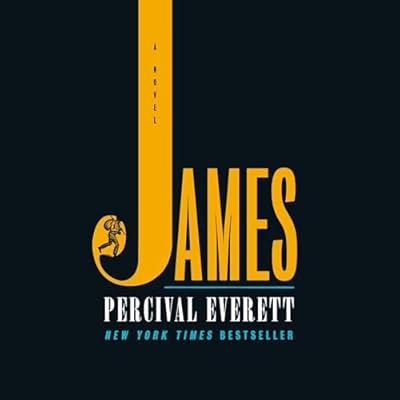
James
Best for listeners who want the most consequential novel of the decade in under eight hours.
Percival Everett retells Huckleberry Finn from Jim's point of view, and the trick is that Jim (here renamed James) has been performing illiteracy for most of his life. He thinks in full philosophical sentences and code-switches into the slave dialect Twain made famous whenever a white person is in the room. The novel is funny, furious, and stunningly economical. It won the National Book Award and the Pulitzer.
The audiobook is the way to read it.
Dominic Hoffman has narrated Everett before (he did Erasure), and he knows how to handle the double-consciousness device. The shift between James's interior English and the public dialect is precise to the syllable. Hoffman never lets it sound like two performances stapled together. Listen for the moment James first speaks to the runaway boys; the calibration in that scene is the audiobook in miniature.

The Women
Best for listeners who want a Vietnam-era epic that earns every tear it asks for.
Frankie McGrath signs up as a combat nurse in Vietnam because her brother told her women could be heroes too. The first half of the book is the war. The second half is what happens to her at home, in a country that pretends the war didn't happen and pretends she wasn't in it. Hannah is at the height of her powers here. She does not blink.
If you've avoided Kristin Hannah on principle, this is the one to convert you.
Julia Whelan is the most consequential audiobook narrator of her generation, and her performance here is one of her best. She doesn't soften Frankie. The scenes in the field hospital are read at a clip that mirrors triage; the scenes at the family home are slower, colder, and exact. Hannah herself narrates the author's note at the end, and it lands harder for it.

Hamnet
Best for listeners who want a Tudor novel that refuses to be about the famous person in the room.
William Shakespeare is in this book, but he is never named, and he is rarely the point. The center is Agnes, his wife, and the death of their eleven-year-old son, Hamnet, in a year when plague was passing through the village. O'Farrell rebuilds the domestic life of Stratford with the kind of sensory detail that makes you smell the rushes on the floor.
It won the Women's Prize for Fiction. It deserved it.
Ell Potter narrates with the unhurried gravity the prose requires. Where another narrator might dramatize Agnes's grief, Potter lets the writing do the work and stays close to the surface. That restraint is what makes the long death scene at the book's center one of the hardest things you'll hear on audio this year. Listen with headphones; the pacing rewards attention.
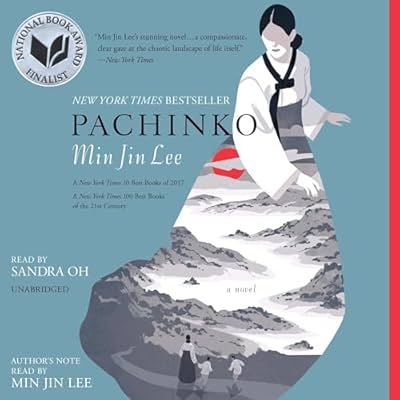
Pachinko
Best for listeners who want a multigenerational saga read by an actor who knows the material in her bones.
Four generations of a Korean family living in Japan, beginning in 1910 and ending in the late twentieth century. Pachinko is a novel about the slow accumulation of cost: what it takes to survive as a Zainichi Korean across a century that did not want you to. Min Jin Lee writes plain, declarative sentences that carry enormous weight.
It is one of the great novels of the 21st century. Full stop.
Sandra Oh is not a journeyman narrator. She narrates because she wanted this book read this way. Her Korean and Japanese name pronunciations are exact; her pacing on the quiet scenes (Sunja at the market, Noa walking to school) is the part of the performance that elevates the audio above the print. The shift in register between the Korean village chapters and the Osaka chapters is barely perceptible on the page; on audio, Oh makes it impossible to miss.
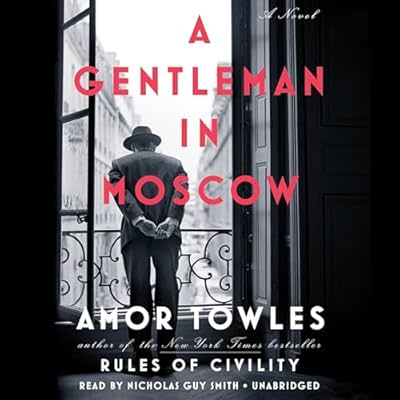
A Gentleman in Moscow
Best for listeners who want a single hotel, three decades, and a narrator who turns every meal into a small event.
Count Alexander Rostov is sentenced to house arrest at Moscow's Metropol Hotel in 1922 and stays there for the next thirty-two years. The Soviet Union changes around him. He attends to small things: wine pairings, friendships, a girl named Nina who teaches him the back hallways. Those small things accumulate into a life. Towles writes with a wry warmth that the audiobook brings out completely.
If you've heard listeners describe an audiobook as "company," this is the one they meant.
Nicholas Guy Smith's voice is mid-Atlantic, slightly clipped, and possessed of perfect comic timing. He sounds like Rostov, which is the entire game. The reading of the famous dinner with Mishka in 1923 is the test scene; if you smile within thirty seconds, you're in for the duration.

Wolf Hall
Best for listeners who want the definitive Tudor novel performed by an actor who literally played Cromwell on stage.
Thomas Cromwell, son of a Putney blacksmith, becomes the most powerful commoner in England by being smarter and more patient than everyone else in the room. Mantel's prose is famously slippery (the pronoun "he" almost always means Cromwell, even when context suggests otherwise), and the print edition rewards rereading. The audiobook solves the problem.
It is, on audio, what it always wanted to be: a man's interior life, dictated.
Ben Miles played Cromwell in the Royal Shakespeare Company's stage adaptation of the trilogy. He recorded the audiobooks afterward, and the performance is the result of two years inside the character. Where the earlier Simon Slater recordings handled the text as text, Miles handles it as voice: Cromwell thinking, watching, weighing. This is the recording to listen to.

The Rose Code
Best for listeners who want Bletchley Park codebreakers, a postwar mystery, and a narrator with a passport's worth of accents.
Three women (a debutante, a working-class linguist, and a chess prodigy) work at Bletchley Park during World War II, fall out, and reunite years later to chase a traitor. Quinn knows the period cold and writes the codebreaking sequences with enough technical detail to feel earned, never enough to bog down. It is the best WWII home-front novel of the past decade.
A good place to start if you've never read Quinn.
Saskia Maarleveld is a one-woman ensemble. She moves between RP, working-class Scottish, German, French, and American accents without ever sounding like she's performing accents. Every voice is character-first. The scenes inside Hut 8 are where the performance shines: dozens of voices in a small room, every one distinct.
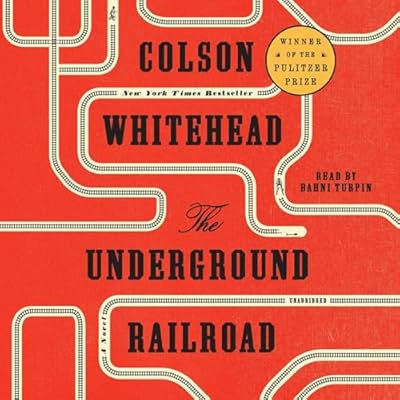
The Underground Railroad
Best for listeners who want a Pulitzer-winner whose narrator is the reason it works on audio.
Cora escapes a Georgia cotton plantation on an underground railroad that is, in Whitehead's novel, an actual subterranean train. Each state she emerges into is a different America, a different argument about what the country was, is, and might have been. The conceit is bold; the execution is exact.
It won the Pulitzer and the National Book Award the same year.
Bahni Turpin is the narrator of a generation. Her Cora is interior, watchful, and never sentimentalized. Turpin handles the shifting-state structure by giving each section a distinct rhythm. The South Carolina segment has a different tempo than the Tennessee segment, and the listener feels the geography change before the prose explains it. One of the great audiobook performances of the 2010s.

Homegoing
Best for listeners who want three hundred years of a family's history in fourteen self-contained chapters.
Two half-sisters born in eighteenth-century Ghana never meet. One marries a British slaver; the other is sold into the trade. The novel follows their descendants down two parallel lines (one in America, one in Ghana) across three centuries, one generation per chapter. Each chapter is a complete short story. Gyasi was twenty-six when she finished it.
Few first novels have done as much in as little space.
Dominic Hoffman handles the structural challenge (fourteen narrators, two continents, three hundred years) by treating each chapter as a distinct world rather than a chapter of a larger book. The Asante chapters and the Mississippi chapters do not sound like the same recording. That's the right choice.

The Pillars of the Earth
Best for listeners who want a 41-hour twelfth-century cathedral epic to live inside for a month.
A medieval English town spends decades building a cathedral. The novel is a soap opera about masons, monks, earls, and the brutal mechanics of twelfth-century politics. Follett is unembarrassed about wanting you to stay up late, and the plotting is shameless in the best sense. Forty-one hours is not a deterrent. Forty-one hours is the point.
The most-listened-to historical novel of the last forty years for a reason.
John Lee narrates with British formality and a remarkable ability to hold the dramatis personae apart over a runtime this long. His Prior Philip is patient and warm; his Waleran Bigod is cold steel. Most listeners report finishing the book and immediately starting World Without End. Lee narrates that one too.
Curated lists
Browse historical fiction by
Every list ranked by narration quality. Sub-lists publish through 2026.
When the story happens shapes how the audiobook reads.
Coming 2026
Best WWII Historical Fiction Audiobooks
Coming 2026
Best Tudor & Renaissance Audiobooks
Coming 2026
Best 20th-Century Historical Audiobooks
Where the casting choices change the experience.
Coming 2026
Best Multi-Cast Historical Audiobooks
Coming 2026
Best Author-Narrated Historical Audiobooks
Depending on how much time you've got.
Coming 2026
Best Long-Form Historical Audiobooks (20+ Hours)
Coming 2026
Best Short Historical Audiobooks (Under 10 Hours)
Narrators who define the genre
Three voices worth following across everything they've recorded
Julia Whelan
Contemporary American · Women-led 20th century · Audible Studios
If you've listened to a Kristin Hannah novel in the last decade, you've heard Julia Whelan. The Women, The Four Winds, and The Great Alone are all her. She also narrates most of V.E. Schwab's catalog. Whelan produces audiobooks too, not just narrates them, which is part of why her catalog feels like a body of work and not a hire-by-hire career.
Bahni Turpin
African-American literary · Multi-state structure · Whitehead, Stockett
Turpin is the narrator publishers call when an African-American novel needs to be on audio. The Underground Railroad and The Nickel Boys (both Whitehead), The Help (Stockett), and dozens of others. Her particular gift is that she can shift register without losing the character. Cora in Georgia and Cora in Tennessee are the same Cora, narrated differently. The geography is in the performance.
Spotlight coming →Dominic Hoffman
Multi-perspective American · Everett, Gyasi, McBride
Hoffman gets the difficult books. Everett's James, Gyasi's Homegoing, McBride's Heaven & Earth Grocery Store. When a novel asks one narrator to carry several Black American voices across different eras, Hoffman is the call. His range is wider than his catalog suggests.
Adjacent shelves
If historical fiction is the starting point
Genre boundaries are editorial fictions. These overlap more than they diverge.
Frequently asked questions
Questions about historical fiction audiobooks
What counts as historical fiction?
A novel set in a real historical period where the period actually matters to the plot. We don't include alternate history with magic or speculative elements (those belong on the fantasy hub), and we don't include contemporary novels that flash back to a historical moment for a few chapters. The genre's fuzzy edge is books like The Invisible Life of Addie LaRue, which spans centuries with a fantastical premise. We kept those off this list and on the fantasy or literary hubs where they fit better.
Are these audiobooks all unabridged?
Yes. Every pick is the full unabridged audio edition. A note on Wolf Hall: there are two unabridged recordings of it. The earlier Simon Slater version is competent. The newer Ben Miles version is what's on this list. Miles played Cromwell on stage with the Royal Shakespeare Company before recording the audiobook, and the difference shows. Pillars of the Earth also has two recordings. The John Lee version is the one to listen to.
Why aren't there more World War II titles?
The WWII shelf is enormous and well-covered elsewhere. We've included two (The Rose Code and, indirectly via the framing essay, The Book Thief) that represent distinct sub-genres: codebreaking thriller and YA-adjacent literary. Doerr's All the Light We Cannot See and Zusak's Book Thief are both cited in the framing essay and would be obvious top-10 picks in a WWII-specific list. A dedicated Best WWII Historical Fiction Audiobooks list is in the browse module above and will publish in 2026.
The Pillars of the Earth is forty-one hours. Is that really worth it?
Yes. The length is the point. Follett is building a world you live in. If you'd rather start shorter, James (7h 49m) is the shortest pick on the list, and The Underground Railroad (10h 43m) is the shortest pick with literary heft. The Pillars of the Earth pays off, but it's a commitment. The book Follett wrote is the book Follett wrote: a generational cathedral-construction epic. Forty-one hours is the natural runtime for that.
Why is Wolf Hall ranked sixth and not first?
It's the hardest pick on the list. Mantel's prose famously uses 'he' to mean Cromwell most of the time, even when other men are in the scene, and print readers complain about it. The audiobook actually fixes the problem because Ben Miles's voice tells you who's speaking. But it's still 25 hours of Tudor political infighting, and you'll do better with it after warming up on the first five picks.
New to Audible? See Audible’s current offer →
How we picked
Selection criteria
We listened to each candidate before deciding. The question we kept asking was: does the narrator's voice belong in the world of this book? A 1530s Tudor novel needs something different from a 1970s Vietnam novel. So we weighted narrator-period fit, how each narrator handles books that switch eras or perspectives mid-stream, character work across long runtimes, and restraint. Most historical fiction doesn't need to be dramatized in the recording. Story quality mattered too, but it came second. Every book here is well-written. Not every book here is in the top ten because of how well it's written. Some are here because of how well it's read.
Coverage matters too. The picks range from 7h 49m to 40h 56m, from the twelfth century to the 1970s, and from intimate single-arc novels to multigenerational sagas. Narrator credits are verified against current Audible editions. Where multiple editions exist, we cite the best one: Wolf Hall is Ben Miles, not Simon Slater. Pillars of the Earth is John Lee. The list gets reviewed annually, and individual picks get swapped when a better-narrated alternative shows up.