Literary Fiction
Best Literary Fiction Audiobooks of 2026
What makes a great literary fiction audiobook
Literary fiction is the genre most likely to depend on a sentence you reread. Most of the action happens inside characters' heads, and you get pulled forward by the texture of the prose itself. The reader's eye lingers, doubles back, parses again. That ritual is exactly what audio doesn't let you do. So a literary novel on audio is doing something specific: it's asking the narrator to perform the texture that the silent reader normally produces themselves.
When it works, it works better than the page. Charlie Thurston as Damon in Demon Copperhead, Tom Hanks as Danny Conroy in The Dutch House, Adjoa Andoh as Ifemelu in Americanah. All three audiobooks make the case that a great narrator can do something the print edition can't. They settle the question of voice. The reader stops auditioning narrators in their head and starts listening.
When it doesn't work, it's because the narrator played it neutral. Literary fiction punishes neutrality. The most-rated, least-loved performances on the genre's shelf are competent readings that left the interiority on the page. The bar for this list was the opposite: the narrator has to be inside the novel, not next to it.
What's on the list. The picks range from a 4h 20m formal experiment (Interior Chinatown) to a 32-hour Pulitzer winner (The Goldfinch). Some are single-narrator masterclasses. David Pittu carries 32 hours of Tartt without ever sounding like the same character twice. Angus King reads Shuggie Bain in working-class Glasgow without ever turning the dialect into costume. Some are multi-cast by design. Sing, Unburied, Sing and There There use multiple narrators because the novels ask for it. Ocean Vuong narrates On Earth We're Briefly Gorgeous himself. He's a poet, and the reading shows.
A few that aren't on the list, but you should still know about them. Meryl Streep narrates Ann Patchett's Tom Lake, and the recording is the best celebrity narration of the last decade. Julia Whelan reads Tomorrow, and Tomorrow, and Tomorrow and the full Trust cast (Edoardo Ballerini, Orlagh Cassidy, Mozhan Marnò, Ivàn Mallarino) is structurally inventive. David Pittu shows up again on Crossroads. All very good. We picked ten.
What's not here. Novels that need their historical period to work belong on the historical fiction hub. Pachinko, Wolf Hall, and James all live there. Genre fiction stays on its own shelf even when the prose is literary. The list above is contemporary or recent-past fiction where the writing and the narrator are doing most of the work.
All 10 picks at a glance
| # | Title | Author | Narrator | Runtime | Listen |
|---|---|---|---|---|---|
| 1 | Demon Copperhead | Barbara Kingsolver | Charlie Thurston | 21h 3m | Listen → |
| 2 | The Dutch House | Ann Patchett | Tom Hanks | 9h 53m | Listen → |
| 3 | Americanah | Chimamanda Ngozi Adichie | Adjoa Andoh | 18h 44m | Listen → |
| 4 | The Goldfinch | Donna Tartt | David Pittu | 32h 24m | Listen → |
| 5 | Shuggie Bain | Douglas Stuart | Angus King | 17h 30m | Listen → |
| 6 | Sing, Unburied, Sing | Jesmyn Ward | Rutina Wesley, Kelvin Harrison Jr., Chris Chalk | 8h 22m | Listen → |
| 7 | Interior Chinatown | Charles Yu | Joel de la Fuente | 4h 20m | Listen → |
| 8 | There There | Tommy Orange | Kyla Garcia, Alma Cuervo, Darrell Dennis, Shaun Taylor-Corbett | 8h 0m | Listen → |
| 9 | Milkman | Anna Burns | Bríd Brennan | 14h 11m | Listen → |
| 10 | On Earth We're Briefly Gorgeous | Ocean Vuong | Ocean Vuong | 7h 19m | Listen → |
The picks · 1–10
Ten, ranked editorially.
Ordering is editorial, not algorithmic. We argued.

Demon Copperhead
Best for listeners who want a David Copperfield retelling set in opioid-era Appalachia, performed as if the narrator grew up there.
Barbara Kingsolver rewrites Dickens through the perspective of a boy born to a teenage mother in the trailers of southern Virginia. Demon (born Damon Fields) tells his own story across roughly two decades, from foster care to football to the OxyContin crisis that eats his community. Kingsolver writes Demon's voice as a vernacular all its own, half country slang and half hard-won literary precision. It won the Pulitzer Prize and the Women's Prize for Fiction the same year.
It's the literary novel of the decade about American poverty. The audiobook is the way to read it.
Charlie Thurston disappears into Damon's voice across more than 21 hours, holding a single character from age 10 to early 20s without ever sounding like an adult performing a child. The Appalachian cadence is exact; the rhythm of Demon's interior asides (sardonic, self-aware, never self-pitying) is what carries the novel's hardest stretches. Audible's full-cast performances usually get the production polish, but this is a one-narrator recording that earns every minute of the runtime. It is the best literary fiction audiobook of the last five years.

The Dutch House
Best for listeners who want a celebrity-narrated audiobook that proves the casting can be the point.
Danny Conroy and his sister Maeve return, over and over, to the suburban Pennsylvania mansion their father bought and their stepmother eventually drove them out of. Patchett writes the novel as a memory exercise: Danny telling the same house story across five decades, watching what the telling does to him. It is short, structured around a single image, and one of the most quietly devastating novels Patchett has written.
If you've been suspicious of celebrity narration, this is the recording that settles it.
Tom Hanks narrates as Danny, and the choice not to do voices for everyone else is the whole game. He reads as one man remembering everyone, which is the novel's actual perspective. Maeve, Andrea, their father: all of them come through Danny's voice, slightly inflected, never impersonated. Patchett wrote the book imagining Hanks; the recording delivers on the imagined version. The scene where Danny and Maeve sit in the car outside the house is the test passage. It works.

Americanah
Best for listeners who want a transcontinental love story performed by a one-woman ensemble.
Ifemelu leaves Lagos for an American university, builds a career writing about race in the United States, and after thirteen years decides to go home. Obinze, her first love, takes a different path through London. Adichie writes both threads with sociological precision and emotional patience, and the novel's set pieces (the hair salon in Trenton, the dinner parties in Princeton, the Lagos return) are extended studies in code-switching.
It's a love story, a culture-clash novel, and the best satire of American liberalism written this century. All three at once.
Adjoa Andoh moves between Nigerian English, Princeton-American, Trenton-American, Cockney London, and a half-dozen other registers without ever sounding like she's performing accents. The novel hinges on Ifemelu's ability to slip between identities, and Andoh's reading makes the slipperiness audible. She has narrated almost every major novel by an African writer of the last fifteen years for a reason. This is the performance to start with.

The Goldfinch
Best for listeners who want a Pulitzer-winning epic carried by one of the great character-work performances on audio.
Theo Decker survives a terrorist bombing at the Met that kills his mother and walks out with a stolen Dutch masterpiece. The next thirty hours follow him through New York foster care, a Las Vegas exile, and a slow descent into the world of antique forgery in Greenwich Village. Tartt writes long sentences, dense interiors, and characters who feel like they could walk off the page. It won the Pulitzer.
Some readers found the print edition too long. Almost nobody who listens to the audiobook does.
David Pittu's Boris is one of the great audiobook character performances of any decade. The Russian-Ukrainian accent is consistent and lived-in across hundreds of pages, and the friendship between Theo and Boris is the part of the novel where the audio outpaces the page. Pittu also handles Theo's interior monologue, Hobie's gentle Connecticut warmth, and Pippa's brittle uncertainty without ever blurring them. Thirty-two hours is the right runtime. He earns it.

Shuggie Bain
Best for listeners who want a Booker-winning Glaswegian novel where the dialect is the architecture.
Shuggie is the youngest of three children of a fading Glasgow beauty named Agnes Bain, whose drinking is killing her in slow installments through the Thatcher years. Stuart writes the novel in close third-person around Shuggie, who is small, gentle, queer in a place that does not yet have words for that, and entirely devoted to a mother who cannot stay sober long enough to be devoted back. It won the Booker Prize.
It is one of the saddest novels written this century, and one of the most beautifully written.
Angus King reads in working-class Glaswegian dialect, and the cadence is the performance. The novel's dialogue is written phonetically in print; on audio, the phonetic spelling falls away and the rhythm takes over. King's Agnes is the recording's centerpiece. She is allowed to be charming, cruel, frightened, and grand within a single conversation, sometimes within a single sentence. Listen with the playback speed where you'd normally set it. The Glaswegian works.

Sing, Unburied, Sing
Best for listeners who want a Mississippi road novel performed by three narrators because the book demands them.
Jojo, a thirteen-year-old Black boy in coastal Mississippi, takes a road trip with his addict mother and toddler sister to pick up his father from Parchman state prison. A ghost from his grandfather's own time at Parchman rides along. Ward writes three perspectives in three distinct cadences. The novel won the National Book Award.
The audiobook's three-narrator structure is one of the rare cases where multi-cast is dictated by the prose, not by the production budget.
Rutina Wesley reads Leonie with the brittle, defensive intelligence of a woman who knows she is failing her children. Kelvin Harrison Jr. is Jojo, careful and watchful and not yet hardened. Chris Chalk voices Richie, the ghost, with a deliberate flatness that places him outside the living timeline. Each narrator is in their own register and the three never blur. It is structural multi-cast, not decorative.

Interior Chinatown
Best for listeners who want a National Book Award winner that reads like a screenplay being performed live.
Willis Wu plays Generic Asian Man on a Law & Order-style police procedural, working his way through the casting tiers (Background Oriental Male, Delivery Guy, Kung Fu Guy) while living in the rooming house above the Chinese restaurant where the show shoots. Yu wrote the entire novel in screenplay format. Stage directions, character names in all caps, scene headings, the whole apparatus. It won the National Book Award.
Short, brutal, and one of the most formally inventive novels of the last decade.
Joel de la Fuente reads the screenplay as a screenplay. The stage directions are voiced. The character names are voiced. The transitions between Willis's interior life and the show he is performing in are handled in tonal shifts that are impossible to fake on the page. De la Fuente is a working stage and screen actor (The Man in the High Castle, Law & Order), and the meta-casting becomes part of the performance. The audiobook is shorter than a feature film. It hits as hard as one.

There There
Best for listeners who want a polyphonic urban Indigenous novel performed by four narrators across twelve perspectives.
Twelve characters converge on the Big Oakland Powwow over the course of a few hundred pages, each carrying a different version of what it means to be Urban Indian in the contemporary Bay Area. Tommy Orange writes the novel in short bursts of close third-person, switching point of view chapter by chapter, building toward a final convergence the reader sees coming and still cannot prepare for. It was a debut, a Pulitzer finalist, and a National Book Critics Circle winner.
One of the defining American novels of the past decade, by one of the writers people will still be reading in fifty years.
Four narrators split the twelve perspectives, which sounds like over-casting until you hear it. Kyla Garcia handles Dene Oxendene and Opal; Darrell Dennis voices Tony Loneman and Edwin Black with two completely distinct rhythms; Alma Cuervo carries Jacquie Red Feather. The multi-cast solves the novel's central audio problem (twelve interiorities in eight hours) by simply giving them different voices. The convergence chapters work better on audio than they do on the page.

Milkman
Best for listeners who want a Booker-winning novel about a young woman stalked by a paramilitary, narrated as one continuous Belfast voice.
An unnamed 18-year-old in an unnamed Northern Irish city in the late 1970s is being followed by an older married man known only as the milkman. The narrator does not want to be followed. The community has decided she must be having an affair. Burns writes the entire novel in a single voice. No characters are named. No paragraphs are short. Quote marks are mostly absent. It won the Booker Prize.
The print edition has a reputation for being difficult. The audiobook makes that reputation feel undeserved.
Bríd Brennan is an Irish stage actress, and her reading is what makes the novel suddenly legible. The Belfast cadence carries the long unbroken sentences. The narrator's dry, sidewise sense of humor (the novel is much funnier on audio than on the page) lands at the right moments. Dialogue without quote marks becomes obvious because Brennan's voice shifts. If you have started Milkman in print and given up, restart on audio. It is the same novel and a different experience.
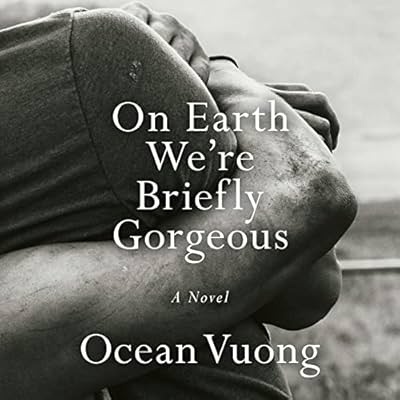
On Earth We're Briefly Gorgeous
Best for listeners who want a Vietnamese-American epistolary novel read aloud by the poet who wrote it.
Little Dog writes a letter to his mother, who cannot read it. The letter is the novel. Vuong moves between the family's escape from postwar Vietnam, his grandmother's life under the war, and his own coming of age in working-class Hartford. The prose is the prose of a poet, lineated by rhythm even when set as prose.
Author-narrated novels are uneven on audio. This is the case that justifies the form.
Vuong is a poet first, and he reads as one. He paces the prose slowly and lets the pauses sit. He treats the lyric passages as poetry and the narrative passages as prose, and the line between them keeps moving. The Vietnamese phrases are pronounced by a speaker, not a performer. The book is short enough to listen to in two sittings, but it asks for one.
Curated lists
Browse literary fiction by
Every list ranked by narration quality. Sub-lists publish through 2026.
What the novel is doing shapes what the audio has to deliver.
Coming 2026
Best Coming-of-Age Literary Audiobooks
Coming 2026
Best Family Saga Literary Audiobooks
Coming 2026
Best Formally Inventive Literary Audiobooks
Where the casting choices change the experience.
Coming 2026
Best Author-Narrated Literary Audiobooks
Coming 2026
Best Multi-Cast Literary Audiobooks
Depending on how much time you've got.
Coming 2026
Best Long-Form Literary Audiobooks (20+ Hours)
Coming 2026
Best Short Literary Audiobooks (Under 8 Hours)
Narrators who define the genre
Three voices worth following across everything they've recorded
David Pittu
Long-form American literary · Tartt, Franzen, Yanagihara
Pittu gets handed the doorstoppers. The Goldfinch and A Little Life are both his. So is Crossroads, the first Franzen of the new century. His range across a single 30-hour recording is wider than most narrators show across a career. When a literary novel needs one voice to hold dozens of characters across decades, publishers call Pittu.
Adjoa Andoh
International literary · Adichie, Aboulela, diaspora writers
Andoh is the narrator most associated with contemporary African and diaspora literary fiction. Americanah, Half of a Yellow Sun, and almost every major Adichie title are hers. Stage-trained (RSC, theater, Bridgerton on screen), she treats narration as performance rather than reading. Her accent range is the part of her work people talk about, but the interior steadiness underneath the accents is the real craft.
Angus King
Scottish & working-class literary · Stuart, McIlvanney, regional writers
King is the call when a literary novel is rooted in a specific regional voice that print can only half-render. Shuggie Bain is the obvious example, but his catalog of working-class British literary fiction is the deeper resource. He treats dialect as cadence, not as costume, which is the only way it actually works.
Adjacent shelves
If literary fiction is the starting point
Genre boundaries are editorial fictions. These overlap more than they diverge.
Frequently asked questions
Questions about literary fiction audiobooks
What counts as literary fiction?
Contemporary or recent-past novels where the writing is the main attraction. The novel rewards the listener sentence by sentence, not chapter by chapter. Historical fiction that depends on its period (James, Wolf Hall, Pachinko, Hamnet) goes to the historical hub. Romance and fantasy stay on their own shelves even when the prose is excellent. The hub is for the kind of novel that ends up on Pulitzer or Booker shortlists.
Are these all unabridged?
Yes. Every pick is the full unabridged audio edition. A note on The Goldfinch: there is only one recording, David Pittu's, and it is the correct one. A note on Demon Copperhead: Charlie Thurston's Audible Studios production is the only edition, and it is one of the best of the decade. On Earth We're Briefly Gorgeous has only the author-read recording, which is the right call.
Why so many recent novels?
Literary fiction by definition has not been around long enough to have a deep audiobook backlist. The audiobook market only became serious in the 2010s, and the great literary recordings of the prior decade are mostly being re-recorded now. The picks here lean recent because the audio editions of the older literary canon (Roth, Updike, DeLillo, Morrison) are uneven. Classics with reliable recordings live on the classics hub when we publish it.
The Goldfinch is 32 hours. Is it worth it?
Yes. Tartt builds Theo's interior life slowly, across a decade of his life, and the audiobook gives that slowness room to work. Print readers complain about the length; audio listeners mostly don't. If you'd rather start shorter, Interior Chinatown (4h 20m) is the shortest pick and one of the most formally inventive novels on the list. On Earth We're Briefly Gorgeous (7h 19m) is the next shortest. The Goldfinch is a commitment. It pays off.
Why are some books on this list and not the historical fiction list?
We ask whether the novel needs its period. Wolf Hall, Pachinko, Hamnet, and James need theirs. Take Tudor England out of Wolf Hall and there's nothing left. Those books live on the historical hub. Demon Copperhead is set during the OxyContin crisis, but Kingsolver isn't reconstructing the era; she's writing Damon's life. Shuggie Bain is set in 1980s Glasgow but follows the same logic. Both live here. A 1970s novel where the period is decoration goes here too.
New to Audible? See Audible’s current offer →
How we picked
Selection criteria
We listened to each candidate before deciding. The question we kept asking was whether the narrator was inside the novel or next to it. Literary fiction punishes neutrality. So we weighted character-work specificity (Pittu's Boris, Andoh's Ifemelu, King's Agnes), formal fit (the screenplay performance on Interior Chinatown, the unbroken voice on Milkman, the lyric pacing on Vuong), and the audio's ability to outpace the page. Story quality mattered too, but it came second. Every book on the list is well-written. Some are on the list because the audiobook adds a voice the print edition couldn't carry, and that addition is what makes the recording the better version.
Coverage matters too. The picks span 4h 20m to 32h 24m and include single-narrator, multi-cast, and author-read recordings. Narrator credits are verified against current Audible editions. The list is reviewed annually, and individual picks get swapped when a better-narrated alternative shows up.