Horror
Best Horror Audiobooks of 2026
What makes a great horror audiobook
Horror is the genre where the production format is the performance. More than any other shelf, horror audiobooks live or die on choices that have nothing to do with story: who narrates, how many, and what shape the recording takes. A novel that's merely unsettling on the page becomes physically affecting when the right narrator gets the right room around them. A book that works fine in print can be claustrophobic in your ears.
The first sign of a good horror narrator is restraint. Horror is full of writers who can make a sentence do the work of three; the narrators who can match them are the ones who don't reach for the obvious vocal flourish. Joniece Abbott-Pratt's performance of The Reformatory holds two perspectives across twenty hours, a Black child in a brutal 1950s reform school and the older sister desperately searching for him, and she gives neither one a stagey theatricality. The horror sits between her lines, not on top of them. Joseph Balderrama narrating Tender Is the Flesh stays clinically calm describing things no one should describe calmly, and the bureaucratic flatness is what makes the body horror land. Restraint is the genre's hardest discipline.
The second quality is structure as voice. Horror audiobooks are uniquely receptive to formats that other genres can't carry. The full-cast survivor-interview format that Max Brooks pioneered with World War Z is essentially documentary; it works because horror's emotional logic is testimony. FantasticLand uses the same trick at smaller scale, with Angela Dawe and Luke Daniels splitting competing accounts of a theme-park collapse, and the unreliability of each voice is the source of the dread. The Buffalo Hunter Hunter nests three narrators inside Stephen Graham Jones's layered Blackfeet vampire-revenge story, and the structure is the meaning: each voice is a different document, and you only realize what you've been listening to once they begin to contradict each other.
The third is the author-narrated case. It rarely works elsewhere. In horror it works because the writers who know how their sentences should sound tend to be the same writers who know how to scare you. Christopher Buehlman has narrated almost all of his own horror novels, and The Lesser Dead is the showcase. His New York vampire's voice is grimy, performative, and not as confident as it pretends to be. No casting director would have caught that combination. Buehlman writes it and reads it because he understands both jobs.
The picks below were chosen on those criteria. Story still matters, and nothing here is narratively weak: most of these books are widely cited as some of the strongest contemporary horror in print. But the audiobook performance had to earn the spot. The result skews recent (eight of ten were recorded after 2018), narrator-first (four are full-cast or multi-narrator productions, one is author-narrated), and structurally varied. From one-narrator interior dread to nested-document folklore, it's a genre that finally has the audio production it deserves.
All 10 picks at a glance
| # | Title | Author | Narrator | Runtime | Listen |
|---|---|---|---|---|---|
| 1 | The Reformatory | Tananarive Due | Joniece Abbott-Pratt | 20h 51m | Listen → |
| 2 | The Buffalo Hunter Hunter | Stephen Graham Jones | Shane Ghostkeeper, Marin Ireland & Owen Teale | 15h 29m | Listen → |
| 3 | World War Z: The Complete Edition | Max Brooks | Full cast including Mark Hamill, Alan Alda & Nathan Fillion | 12h 9m | Listen → |
| 4 | Pet Sematary | Stephen King | Michael C. Hall | 15h 41m | Listen → |
| 5 | The Only Good Indians | Stephen Graham Jones | Shaun Taylor-Corbett | 8h 37m | Listen → |
| 6 | The Lesser Dead | Christopher Buehlman | Christopher Buehlman | 9h 40m | Listen → |
| 7 | FantasticLand | Mike Bockoven | Angela Dawe & Luke Daniels | 10h 1m | Listen → |
| 8 | Boys in the Valley | Philip Fracassi | David Aaron Baker | 10h 55m | Listen → |
| 9 | Play Nice | Rachel Harrison | Alex Finke & Natasha Soudek | 10h 17m | Listen → |
| 10 | Tender Is the Flesh | Agustina Bazterrica | Joseph Balderrama | 6h 44m | Listen → |
Already heard the King and Hendrix picks? The under-the-radar list is ten deep cuts that never made a bestseller shelf.
The picks · 1–10
Ten, ranked editorially.
Ordering is editorial, not algorithmic. We argued.
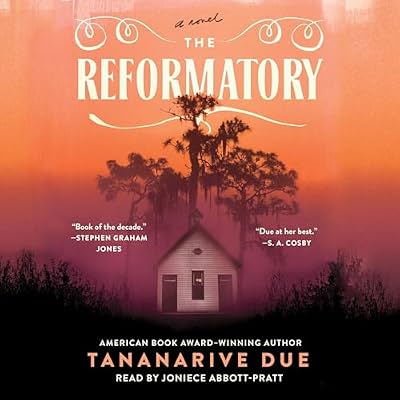
The Reformatory
Best for the listener who wants narration to do the heavy emotional lifting.
Tananarive Due's 2023 novel sets a Black child in a 1950s Florida reform school where the dead haunt the living and the living haunt each other. The dual-perspective structure (Robbie inside the Reformatory, Gloria desperately searching from outside) is what makes the twenty-one-hour runtime move; Abbott-Pratt's job is to keep both voices alive across that span without losing the distinction between them.
Audible's 2023 editor list called the dual-perspective narration an audio experience. It is.
Abbott-Pratt's restraint is the performance. She gives Robbie the cautious, calibrated speech of a child trying to survive adults who can hurt him, and Gloria a stiffer older-sister authority slowly cracking under fear. The book's most upsetting scenes are the ones where she pulls her voice back, not toward, and lets the listener's imagination finish the work.

The Buffalo Hunter Hunter
Best for hearing how casting can rebuild a novel.
Stephen Graham Jones's nested Blackfeet vampire-revenge story moves through three layered documents: a Lutheran pastor's diary, the testimony of an immortal Blackfeet vampire named Good Stab, and the present-day descendant who assembles them. The structure asks the audiobook to do something most books can't, which is make three documentary registers audibly distinct without flattening any of them. The production cast accordingly.
This is the 2025 release Audible singled out as one of the year's best-narrated horror titles. It earns it.
Shane Ghostkeeper carries Good Stab's voice with a deliberate, oral-tradition pacing that holds the book's center of gravity. Marin Ireland's pastor reads like a real diary: earnest, repressive, slowly losing his theology. Owen Teale's framing narrator sounds like a man assembling a case he isn't sure he wants resolved. Three documents, three voices, and the contradictions between them is where the dread lives.
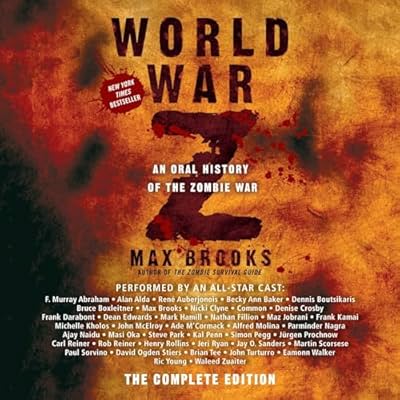
World War Z: The Complete Edition
Best for hearing what audio-first horror actually means.
Max Brooks's oral history of a global zombie war is the case study every horror audiobook conversation eventually returns to. The Complete Edition full cast (Mark Hamill, Alan Alda, Martin Scorsese, Nathan Fillion, Simon Pegg, Common, and roughly two dozen others) treats Brooks's survivor interviews as actual documentary recordings, with each voice cast for the geography and class of its speaker. The result isn't an audiobook of a novel. It's the novel reformatted into the medium it always wanted to be.
The format itself is the argument. No other production has reproduced this convincingly.
The casting is the performance. Hamill's Russian colonel doesn't sound like Mark Hamill doing an accent: it sounds like a Russian colonel. Alan Alda's blowhard pundit could be lifted from a real cable broadcast. The accumulation of voices, each delivered as a believable testimonial, is what makes the global-scale premise land at a human one.

Pet Sematary
Best for the King fan who wants the recent recording, not the legacy one.
Stephen King's bleakest novel is also his most quietly devastating audiobook in this Simon & Schuster re-recording. The production gives Michael C. Hall a single voice to inhabit, and Hall — who spent eight years playing a character whose interior register was a serial killer's deadpan — uses that same control to render Louis Creed's slow disintegration. The book's horror has always been domestic. The audiobook makes the domesticity the engine.
King in audio is an enormous category. This is the one to start with if you want to know what celebrity-narrator casting looks like when it works.
Hall doesn't reach for fear. He plays Louis as a man whose rationality is the engine of the tragedy: a doctor who keeps choosing the choices that ruin him because each one looks, in the moment, like the obvious response to grief. The flatness is the horror. Anyone reading this performance as restrained needs to listen again to the chapters where Louis is alone with his decisions.

The Only Good Indians
Best for the listener who wants narration that gets out of the way.
Stephen Graham Jones's 2020 novel follows four Indigenous men stalked by the consequences of a disturbing elk-hunting incident from their youth. The book's reputation rests on its restraint and its refusal to spectacle, and the audiobook reads the room: Shaun Taylor-Corbett narrates without ever amping up the dread the prose is already building.
One of the rare contemporary horror titles where the narrator's choice to underperform is the right call.
Taylor-Corbett trusts the writing. He keeps the four men's voices distinct without overdoing the accents, lets the silences sit, and refuses to dramatize the supernatural elements the prose deliberately keeps ambiguous. By the time the book's central setpiece arrives, the steady tone has built the kind of pressure no over-narrated version could have produced.
Comparison list
If you loved one of these…
Start from a book you know. The deep-dive list below is built around what made the original work as an audiobook, not just as a story.

The Lesser Dead
Best for the case that author-narration belongs in horror.
Christopher Buehlman's 1970s New York vampire story is narrated by Joey Peacock, an immortal predator who is much less in control than he pretends to be and a much less reliable narrator than he sounds. Buehlman has narrated nearly all of his own horror novels because he understands a specific thing about his prose: the cadence is the character. No casting director would have given Joey this exact voice.
The strongest case in modern horror that the author-narrator model can outperform a hired one.
Buehlman's Joey is theatrical, snide, and intermittently funny, and the audio production makes his performative confidence work as misdirection. The novel's late-act reveal lands harder in audio than print precisely because Joey's voice has been doing one thing for nine hours and is suddenly doing another. A performance only the author could give.

FantasticLand
Best for the listener who liked World War Z and wants the next one down.
Mike Bockoven's slasher-survivor-interview novel takes the oral-history format Brooks established and applies it to a smaller, ranker setting: a Florida theme park where employees are trapped inside by a hurricane and the social structure collapses into territorial factions. Dawe and Daniels split the testimonies between them, and the interviews are framed as recorded, often unreliable, often hostile. The structure is the dread.
If World War Z is the case for the format at global scale, this is the case for it at small ugly human scale.
Dawe and Daniels both have the trick of letting characters incriminate themselves through tone. Park employees describing what their faction did during the crisis tell the listener far more about who they've become than the prose does. The pleasure is in catching the gap between what each speaker thinks they're saying and what the audiobook is making you hear.

Boys in the Valley
Best for the listener who wants religious horror to actually be scary.
Philip Fracassi's 2021 novel sets a wounded stranger arriving at a remote Pennsylvania orphanage during a blizzard, bringing an occult infection that turns boys against one another and against the priests trying to govern them. The premise is The Exorcist crossed with Lord of the Flies, and the audiobook's success rests on selling both halves: the institutional religious dread and the children's POV at the center of it, without tipping either one into camp.
One of the better single-narrator horror performances of the last five years.
David Aaron Baker's narration earns its sinister label honestly. He differentiates the boys carefully without ever giving them stagey juvenile voices, and his priests range from earnest to depraved without sliding into the obvious Father-O'Whoever register. The slow tonal turn across the second half is paced exactly right.

Play Nice
Best for the very current possession-and-family-trauma listener.
Rachel Harrison's 2025 novel follows a woman returning to renovate her childhood home and discovering that the family history she'd been spared from is still very much in the building. The dual-narrator casting splits her present-day voice from the voice of what's been waiting for her. The production is recent enough that the brand-voice argument writes itself: this is what contemporary horror audiobook production sounds like in 2025.
Audible's 2025 horror list called the dual narration powerful and memorable. It is, and it's also the reason the book works at the speed it does.
Finke gives the protagonist a present-day directness that grounds the supernatural material; Soudek's counter-narration is wronger, older, more performatively gentle. The split isn't a gimmick. The book's central question is whose voice you've been listening to, and the production is built to make the answer audible only in retrospect.

Tender Is the Flesh
Best for the listener who wants the shortest, most upsetting pick on the list.
Agustina Bazterrica's 2017 dystopia (translated from Spanish in 2020) sits inside a near-future where animal meat is unsafe and legalized cannibalism has become an industry. The novel is a procedural, working through the bureaucracy of a worker at a special-meat processing plant. The premise sounds like exploitation. The book reads like a regulation manual. The audio production extends that strategy.
The closing pick is the shortest by an hour, and the one most likely to make you stop the car.
Joseph Balderrama narrates as if reading a corporate compliance document. The clinical register is the performance: not a single moment where his delivery does the work the language has already done. The result feels not like a novel being narrated but like a deposition being given, and that's exactly what makes the body horror unbearable.
Curated lists
Browse horror by
Every list ranked by narration quality. Sub-lists publish through 2026.
The great horror hiding off the front table.
Where the casting choices do the work.
Coming 2026
Best Full-Cast Horror Audiobooks
Coming 2026
Best Author-Narrated Horror Audiobooks
Different routes into the shelf.
Coming 2026
Best Possession & Occult Horror Audiobooks
Coming 2026
Best Body Horror Audiobooks
Depending on how much time you've got.
Coming 2026
Best Short Horror Audiobooks (Under 8 Hours)
Coming 2026
Best Long-Form Horror Audiobooks (15+ Hours)
Narrators who define the genre
Three voices worth following across everything they've recorded
Christopher Buehlman
Author-narrated horror · Vampire · Literary
The strongest argument in modern horror that the writer should be the one reading. Buehlman has narrated almost all of his own novels (The Lesser Dead, The Suicide Motor Club, Between Two Fires), and the cadence is unmistakably his. His specialty is performative confidence that's slowly revealed as misdirection. The reveal lands in audio because his voice did the foreshadowing the prose was careful not to.
Joniece Abbott-Pratt
Literary horror · Multi-perspective · Restraint
The Reformatory is the masterclass: two characters across twenty hours, neither one performed for sympathy. Her catalog ranges across literary fiction (The Vanishing Half, Heaven & Earth Grocery Store), but her horror work specifically benefits from a discipline she's built across genres. The most-upsetting moments are the ones where she pulls her voice back, not toward.
Spotlight coming →Michael C. Hall
Celebrity narrator · Domestic dread · Single-narrator
The celebrity-narrator slot in horror is usually a marketing decision dressed as a casting one. Hall is the exception. Pet Sematary's Louis Creed sits in exactly the register he's built across two decades on screen: rational, contained, unsentimental about his own undoing. His audiobook catalog is small, and that's the point. He records when the role is right for him.
Adjacent shelves
If horror is the starting point
Genre boundaries are editorial fictions. These overlap more than they diverge.
Frequently asked questions
Questions about horror audiobooks
What makes a great horror audiobook narrator?
Three things, in order: restraint, structural sensitivity, and trust in the prose. The narrators who land in this list (Joniece Abbott-Pratt, Christopher Buehlman, Joseph Balderrama, Shaun Taylor-Corbett) all share a refusal to amp up dread the writing has already built. Horror doesn't reward vocal performance. It rewards a narrator who knows when to pull back, when to let silence sit, and when to let the listener's imagination do the rest. Casting in horror audiobooks is also unusually consequential. Full-cast productions like World War Z and FantasticLand and multi-narrator structures like The Buffalo Hunter Hunter aren't gimmicks: in horror they're often the point. The right cast can rebuild a novel from the document up.
Is Stephen King the best horror audiobook author?
No, though he's the most-listened-to and several of his audiobook productions are genuinely great (Pet Sematary with Michael C. Hall and 11/22/63 with Craig Wasson are both standouts). But contemporary horror audio is much wider than King. The strongest narration-first horror audiobooks of the last decade are largely from other writers: Tananarive Due, Stephen Graham Jones, Christopher Buehlman, Paul Tremblay, Catriona Ward, Silvia Moreno-Garcia, T. Kingfisher. If you're building a horror-audio listening habit and only listening to King, you're hearing the most famous version of one register of the genre. The shelf is much richer than that.
Which horror audiobooks are full-cast productions?
Full-cast is the format horror benefits from most, and it's still relatively rare. From this list, the clearest examples are World War Z: The Complete Edition (a roughly two-dozen-actor cast including Mark Hamill, Alan Alda, Nathan Fillion, and Common), The Buffalo Hunter Hunter (three narrators handling nested documents), FantasticLand (Angela Dawe and Luke Daniels splitting survivor testimonies), and Play Nice (Alex Finke and Natasha Soudek in a dual-perspective casting that resolves a structural question in the novel). Max Brooks's Devolution, not on this list, is also full-cast and worth seeking out.
Are horror audiobooks scarier than the books in print?
Often, yes, and the reason is mechanical: audio takes away the reader's ability to pace themselves. On the page, you can speed-read past a sentence that's starting to upset you. In audio, the sentence arrives at the pace the narrator chose, and there's no way to flinch ahead. Production design matters too. A capable narrator's silences, a full cast's vocal contrasts, an author-narrator's cadence — all are tools horror writers don't have in print. The titles in this list were chosen partly because they exploit that asymmetry. If you're new to horror, audio is often the harder format to handle, not the easier one.
Where do I start with horror audiobooks if I'm new?
Start with The Only Good Indians (8h 37m, Shaun Taylor-Corbett) for a contemporary literary entry that doesn't punish you with a long runtime, or Tender Is the Flesh (6h 44m, Joseph Balderrama) if you want to test how clinical body-horror lands in audio. Both are under nine hours, both are widely regarded as some of the best contemporary horror of the last five years, and both have narrators who model the genre's underperform-the-dread discipline. Avoid starting with The Buffalo Hunter Hunter or The Reformatory: both are genuinely great, both are long, and both ask more of the listener than a first horror audiobook should.
New to Audible? See Audible’s current offer →
How we picked
Selection criteria
Picks were evaluated on narration first: restraint in delivery, sensitivity to the novel's structural format, character differentiation across cast or POVs, and the capacity to let the listener's imagination finish the work the prose started. Story quality was a secondary criterion. Nothing here is narratively weak, but the audiobook performance had to earn its place independently of the book's critical reception or sales rank.
The list skews contemporary by design: eight of ten picks were recorded after 2018, reflecting the genre's recent shift toward narrator-first production. Narrator credits are verified against current Audible editions; where multiple editions exist, the most significant production is cited (notably Pet Sematary, which has multiple unabridged recordings: the Michael C. Hall edition is the one cited here). The list is reviewed annually, and individual picks are replaced when a better-narrated alternative emerges or when a cited edition is discontinued.