Horror
The Scariest Audiobooks
This is not a list of the best-written horror novels. It's a list of the audiobooks that are actually frightening to listen to, because audio does something the page can't: it takes away your ability to pace yourself. On the page you can skim past the sentence that's getting to you. In your ears, it arrives at the narrator's speed, in the dark, usually through headphones, with no way to flinch ahead.
The picks below are ordered by how hard each recording exploits that. Some are canonical scares; some are quiet, interior dread; one is a slow Southern-gothic outlier we couldn't leave off. What they share is a narrator who understands that in horror, restraint frightens more than performance.
What makes an audiobook scary in audio
Inescapable pacing
You can't speed-read past the bad part. The dread arrives when the narrator decides, not when you're ready for it, and that loss of control is the whole weapon.
Withheld dread
The best horror narrators underperform. They pull the voice back rather than pushing it, and let your imagination finish the work, which is far scarier than any vocal flourish.
Audio intimacy
A voice in your ears is closer than words on a page. A child narrator, a clinical monotone, or a single voice alone in the dark hits harder through headphones than it ever could in print.
All 10 picks at a glance
| Title | Narrator | Runtime | Best For | The Hook |
|---|---|---|---|---|
| Incidents Around the House | Delanie Nicole Gill | 8h 23m | Sustained, inescapable dread | A child narrator you can't unhear |
| I'm Thinking of Ending Things | Candace Thaxton | 5h 22m | Creeping wrongness | Something is off the whole time |
| The Exorcist | Blatty & Eliana Shaskan | 12h 51m | The canonical scare | Author-read, still terrifying |
| Pet Sematary | Michael C. Hall | 15h 41m | Domestic devastation | King's bleakest, read low and flat |
| Come Closer | Julie McKay | 3h 40m | A fast, disorienting spiral | Under four hours, deeply wrong |
| The Luminous Dead | Adenrele Ojo | 14h 09m | Claustrophobic isolation | Alone in the dark, literally |
| Misery | Lindsay Crouse | 12h 11m | Human, no supernatural | The monster is a fan |
| Cold Moon Over Babylon | Scott Brick | 9h 41m | Southern-gothic vengeance | A drowned-town revenge |
| Tender Is the Flesh | Joseph Balderrama | 6h 44m | Clinical body horror | The one that makes you stop the car |
| Elementals | R.C. Bray | 7h 52m | Slow-burn Southern gothic | A cult classic, perfectly cast |
Want the same dread from books you've never heard of? The under-the-radar horror list is ten deep cuts that never made a bestseller shelf.
The picks · 1–10
Ten, ordered by how far they get under your skin.
Order is editorial: how completely each recording delivers the fear a book can only reach in audio. The last pick is a discovery.
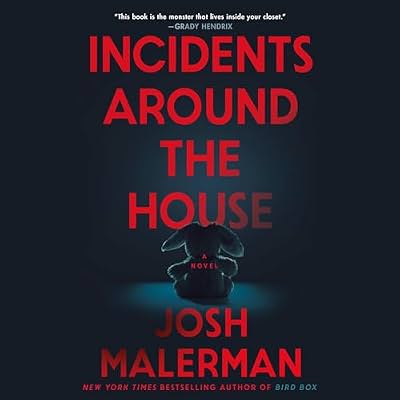
Incidents Around the House
Best for the listener who wants the fear to never once let up.
Malerman tells the whole story through the voice of a small child, Bela, whose imaginary friend Other Mommy wants something no parent could give. The child's-eye narration is the trap: you understand the danger long before Bela does, and the gap between what she reports and what you realize is a slow, constant pressure. It is the rare horror novel that finds a new engine for dread and runs it wall to wall.
Delanie Nicole Gill voices Bela without a trace of adult knowingness, and that innocence is exactly what makes it unbearable. In audio you can't read ahead of the child's understanding the way you can on the page, so the dread arrives on her schedule, not yours.

I'm Thinking of Ending Things
Best for the listener who likes dread that hides inside an ordinary conversation.
A woman drives through a snowstorm to meet her boyfriend's parents while quietly narrating her decision to end the relationship, and for a long time almost nothing overtly frightening happens. The horror is atmospheric and interior: a wrongness that accumulates in the ordinary until the floor drops out. It rewards the listener who can sit inside discomfort and wait.
Candace Thaxton keeps the narrator calm and reasonable even as the ground shifts, and the restraint is what sells it. Heard aloud, the flat everyday tone makes the wrongness harder to dismiss than it is in print, because you can't skim past the parts that unsettle you.

The Exorcist
Best for the listener who wants the benchmark, read by the man who wrote it.
The novel that set the standard for possession horror is still, decades on, one of the most frightening things you can put in your ears. Blatty's procedural patience, the medicine, the doubt, the slow elimination of every rational explanation, is what makes the supernatural turn land. This edition pairs the author with a second voice, and the documentary texture suits the material.
Blatty reading his own novel gives it a strange authority: he knows exactly which lines are meant to frighten and refuses to oversell them. Eliana Shaskan's contributions add contrast without tipping into theatrics, and the two-voice structure keeps twelve hours of mounting dread legible.

Pet Sematary
Best for the listener who wants grief itself to be the monster.
King's bleakest novel turns a father's grief into the engine of his own ruin: Louis Creed keeps making the reasonable-seeming choice that destroys him. The horror has always been domestic rather than gory, which is exactly why it works read low and flat. It gets worse the more calmly it is delivered.
Michael C. Hall plays Louis as a rational man narrating his own undoing, the same contained register he built over years on screen. He never reaches for fear; the flatness is the horror, and in audio that restraint makes the final act land like a weight.

Come Closer
Best for the listener who wants to be unsettled in a single sitting.
A composed young professional starts doing things she can't explain, and the novel charts her slide from rational denial into something else with terrifying economy. At under four hours it is the tightest, most disorienting pick here: possession told from inside the possessed, with no comforting distance. You finish it in one sitting and it stays with you.
Julie McKay keeps the narrator sounding sane and self-assured well past the point the listener knows she isn't, and that dissonance is the whole effect. Heard in one short, unbroken sitting, the calm voice makes the loss of control genuinely frightening.

The Luminous Dead
Best for the listener whose worst fear is being trapped and alone.
A caver takes a lucrative solo job deep underground with only a voice on the comms for company, and the voice may be lying to her. It is survival horror built on isolation, sensory deprivation, and the terror of not being able to trust the one person who can get you out. The dark is total, and the book makes you feel every meter of rock overhead.
Adenrele Ojo carries a nearly one-woman show for fourteen hours, holding both the caver's fraying nerve and the disembodied handler's unreliable calm. Through headphones the effect is claustrophobic in a way print can't touch: her voice is the only company you, and she, have.

Misery
Best for the listener who finds real people scarier than ghosts.
A bestselling novelist wakes after a crash to find he has been rescued by his self-described number one fan, and that she has no intention of letting him leave. There is nothing supernatural here; the horror is captivity, dependence, and a captor whose moods turn on a single sentence. It is King at his most grounded and, for many, his most frightening.
Lindsay Crouse makes Annie Wilkes terrifying precisely by keeping her folksy and bright until she isn't, so every mood shift lands like a trapdoor. In audio her cheerful cadence is the threat, and you learn to brace for the turn the way the man in the bed does.

Cold Moon Over Babylon
Best for the listener who wants patient, waterlogged dread.
McDowell's small-town Florida horror opens with a murder on a dark river and builds into a supernatural revenge that rises like floodwater. His gift is domestic patience: ordinary lives rendered so precisely that the eventual horror feels like it grew out of the mud. It is a slower burn than the canonical scares here, and the payoff earns the wait.
Scott Brick narrates with the deliberate, gathering weight he is known for, letting McDowell's dread pool rather than spike. It is a measured Southern-gothic reading that trusts the material, and if his voice is the draw, he has a full ListenNext narrator spotlight.

Tender Is the Flesh
Best for the listener who wants the most upsetting pick on the list.
In a near-future where a virus has made animal meat lethal, humans are bred and processed for consumption, and the novel follows a plant worker through the bureaucracy of it with flat, procedural calm. The restraint is the horror: it reads like a compliance manual for the unthinkable. It is the shortest devastating listen here, and the one most likely to make you stop the car.
Joseph Balderrama narrates as if reading a corporate document, never once letting his delivery do the work the language already does. That clinical flatness is unbearable in audio: there is no narrator's flinch to hide behind, only the calm recitation of things no one should say calmly.

Elementals
Best for the listener ready to trade jump-scares for creeping, sun-bleached dread.
Two genteel Southern families share a stretch of Alabama beach with three Victorian houses, one of them slowly being swallowed by sand and occupied by something that is not a ghost in any usual sense. McDowell's dread is patient, domestic, and deeply strange. This is the pick a straight fear ranking would never surface, which is exactly why it is here: it broadens what scary can sound like.
R.C. Bray, one of the most sought-after voices in audio, brings his controlled menace to McDowell's languid Southern register, and the mismatch is the pleasure: a modern thriller narrator perfectly at home in 1980s gothic. It is the discovery of the list, and the narration is the reason to trust it.
Frequently asked questions
Scary listening, answered
What is the scariest audiobook?
Incidents Around the House tops this list. Josh Malerman tells the whole story through a small child's voice, and in audio you can't read ahead of her understanding, so the dread never lets up. If you want the canonical scare instead, The Exorcist remains one of the most frightening things you can put in your ears, read by the author himself.
Are audiobooks scarier than reading horror in print?
Often, yes. Audio takes away your ability to pace yourself: on the page you can skim past the sentence that's getting to you, but a narrator delivers it at their chosen speed, in the dark, usually through headphones. Every pick here was chosen partly because it exploits that, from Come Closer's calm unraveling to The Luminous Dead's total underground darkness.
What makes a horror audiobook scary rather than just good?
Three things: pacing you can't escape, a narrator who withholds dread rather than performing it, and point-of-view or production choices that print can't reproduce. A flat, clinical read of Tender Is the Flesh or a child narrating Incidents Around the House frightens more than any amount of vocal theatrics.
Where should I start if I'm new to horror audio?
Come Closer (3h 40m) or Tender Is the Flesh (6h 44m). Both are short, both are widely regarded as among the most unsettling horror of recent years, and both model the genre's underperform-the-dread discipline without asking for a long commitment.
What's the shortest scary audiobook here?
Come Closer at 3 hours 40 minutes is the shortest, and it is built to disorient you in a single sitting. Tender Is the Flesh (6h 44m) is the next shortest and arguably the most upsetting on the list. Neither overstays; both land hard.
Adjacent shelves
More from ListenNext
New to Audible? See Audible’s current offer →
How we picked
How we chose
Every pick was chosen for one job: to frighten you as an audiobook. We scored candidates on the fear a recording can produce that print can't, pacing you can't outrun, dread the narrator withholds rather than performs, and the intimacy of a voice in your ears, then ordered them by how far each one pushes it. Titles that are merely gruesome rather than frightening, or that lose their grip when read aloud, were left off however strong they are on the page.
One pick, Elementals, is a discovery: a slower, stranger title a pure fear ranking would never surface, included because R.C. Bray's narration and McDowell's patient dread broaden what scary can sound like. The scores that drove selection and order are kept behind the scenes; the ranking you see is editorial.