Fantasy
Audiobooks Like The Way of Kings

If forty-five hours felt short and you surfaced from Roshar wanting a world just as heavy to sink back into, this list picks up exactly where Kramer and Reading left you.
What makes The Way of Kings work: a world built to a load-bearing depth, where history, religion, and weather all do real work, a magic system with hard constraints and rules you can feel the physics of, and a massive cast carried across braided arcs by narrators who never perform over the top of the prose. Every pick on this list shares at least one.
All 10 picks at a glance
| # | Title | Author | Narrator | Runtime | Listen |
|---|---|---|---|---|---|
| 1 | The Eye of the World | Robert Jordan | Michael Kramer & Kate Reading | 29h 57m | Listen → |
| 2 | The Shadow of What Was Lost | James Islington | Michael Kramer | 25h 28m | Listen → |
| 3 | The Black Prism | Brent Weeks | Simon Vance | 21h 26m | Listen → |
| 4 | The Dragonbone Chair | Tad Williams | Andrew Wincott | 33h 12m | Listen → |
| 5 | The Priory of the Orange Tree | Samantha Shannon | Liyah Summers | 25h 52m | Listen → |
| 6 | The Ember Blade | Chris Wooding | Simon Bubb | 30h 40m | Listen → |
| 7 | Promise of Blood | Brian McClellan | Christian Rodska | 19h 01m | Listen → |
| 8 | The Blade Itself | Joe Abercrombie | Steven Pacey | 22h 15m | Listen → |
| 9 | The Rage of Dragons | Evan Winter | Prentice Onayemi | 16h 15m | Listen → |
| 10 | Shōgun (Part One) | James Clavell | Ralph Lister | 24h 18m | Listen → |
What keeps Way of Kings listeners hooked
Michael Kramer and Kate Reading do not read The Way of Kings so much as hold the roof up over it. Forty-five hours is a serious narrative ask, and the reason it never sags is that neither narrator ever strains for effect. Kramer keeps Kaladin's despair a half-step short of melodrama, ensuring the climbs out of it actually land. Reading gives Shallan wit without a trace of winking. Roshar is a world engineered down to its highstorms and its spren, and the performance treats all of it as plain fact, which is exactly why the awe sneaks up on you.
What sends a Stormlight listener back to the shelf is scale that has been earned rather than merely announced. Depth of world, weight of history, a magic with real boundaries, and an ensemble cast you can follow across thousands of pages without losing the thread. The ten picks below are ranked by how completely each recording rebuilds that feeling, with narration performance weighted highest. Every one of them is a world you can live inside, not just a story you finish.
Two honest notes before you start. Tone and vintage vary across these selections: The Blade Itself runs far grimmer than Sanderson, The Dragonbone Chair is a classic, old-school slow burn that takes its time on purpose, and the final pick isn't fantasy at all. Where a recording diverges from the Sanderson template, the copy flags it plainly so you can choose your own path.
The picks · 1–10
Ten worlds, ranked by how close they get to Roshar.
Order reflects how completely each recording recreates the Way of Kings experience, with narration weighted highest.
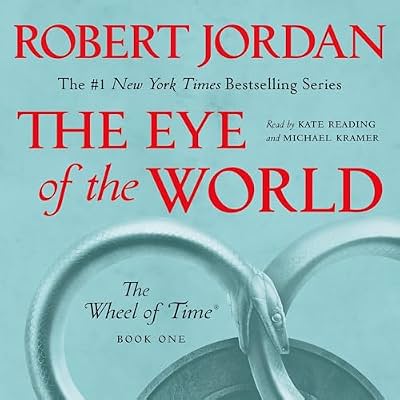
The Eye of the World
Best for keeping the Stormlight voice for another fourteen books.
Why it matches: The same narration duo as The Way of Kings, carrying a fourteen-book epic instead of a ten-book one.
The obvious next step, and the right one. Robert Jordan built the fourteen-volume epic that taught modern fantasy how to go big. This recording matches the exact appetite for scope you brought over from Roshar: a world with deep history beneath its floorboards, a patient, architectural build, and a payoff measured in entire books rather than chapters. Start here and you won't need to look for your next series for a very long time.
This is the Kramer and Reading edition, the same duo reading The Way of Kings, so the voice you leaned on for forty-five hours carries you into the Two Rivers without a seam. Rosamund Pike's 2021 recording is a real alternative, slower and crisper, and it won an Audie, but she stops after book four while Kramer and Reading carry all fourteen. Start where you can stay.
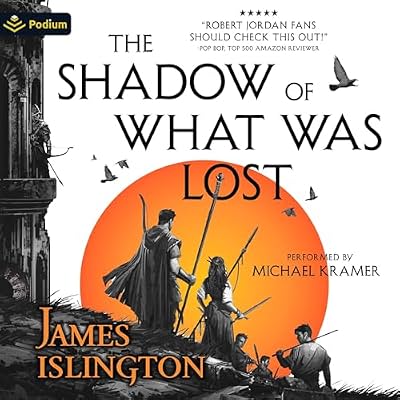
The Shadow of What Was Lost
Best for the puzzle-box magic, with Kramer solo.
Why it matches: Kramer again, this time over a rule-bound magic system built the way Sanderson builds his.
Islington writes with a Sanderson-shaped brain. The world features a rule-bound magic called the Gift, a rigid, highly stratified society built on top of it, and a multi-layered plot that constantly rewards you for paying attention to the structural machinery. It wears its classic-epic influences openly, and if the puzzle-box construction of Stormlight is what hooked you, this is the closest structural engine on the list.
This is Michael Kramer without Kate Reading, a chance to hear him anchor a massive epic solo. His vocal range here is theatrical and wide: guttural and intense for the war scenes, hushed and focused for the mechanics of the Gift. A minor caveat is that some listeners find his lighter secondary character voices run broad, though it rarely pulls you out of the story.

The Black Prism
Best for magic with hard physics and a price attached.
Why it matches: Chromaturgy runs on hard limits and a real cost, the same engineered logic that drives Stormlight's magic.
Chromaturgy is about as rule-bound as magic gets: drafting light into tangible, physical substance, governed by hard physical limits and a devastating personal cost. If the clear physics of Stormlight's magic pulled you in, Weeks scratches that exact structural itch. Add in empire-scale political maneuvering and a morally slippery cast, and it earns a permanent spot right next to Roshar on your shelf.
Simon Vance navigates a massive cast with crisp, patrician diction and never lets two speakers blur, a massive asset in a series this politically crowded. He keeps the complex color-magic mechanics completely legible without ever making the performance sound like a technical manual.

The Dragonbone Chair
Best for the deepest, most patient worldbuilding here.
The ancestor. Tad Williams wrote the massive doorstopper that George R. R. Martin, Brandon Sanderson, and half the modern genre grew up on. It is a deliberate, beautifully paced slow burn involving a scullery boy, a dying king, and a world where ancient history presses heavily on every page. Fair warning: it takes its time before the plot fully takes off. But if you want the deep, patient worldbuilding that made Stormlight feel bottomless, the patience pays off completely.
Wincott, an Earphones Award winner, reads with the gravitas of an old-school storyteller sharing a history that matters. His cadence is unhurried and warm, closer to a fireside chronicle than a frantic battlefield broadcast, which is exactly what a book of this vintage requires.

The Priory of the Orange Tree
Best for one complete epic instead of a ten-book commitment.
If Stormlight's commitment thrills you but a ten-book runway feels daunting, Samantha Shannon's standalone epic is the perfect pivot. It delivers a complete, continent-spanning narrative with ancient dragons, warring global religions, and four braided points of view, all elegantly resolved inside a single volume. The worldbuilding runs Sanderson-deep, but it never asks you to wait a decade for the conclusion.
Liyah Summers moves between a besieged queen's tense court and a dragon-riding Eastern empire without ever letting the threads tangle. She infuses the mythology with a liturgical weight that makes the world feel genuinely old and storied.

The Ember Blade
Best for classic epic fantasy done exceptionally well.
Chris Wooding takes the classic archetypes of high fantasy and executes them at a level that reminds you exactly why those tropes endure: an occupied homeland, a reluctant hero, a dangerous quest with an ancient blade at the center. This is a rich, thirty-hour world you can completely vanish into, built for the listener who wants the comfort of traditional epic fantasy done exceptionally well rather than radically subverted.
Simon Bubb gives every member of the central ensemble a distinct, thoroughly considered voice. Listeners routinely rank his performance among the very best in modern fantasy, mentioning him in the same breath as Tim Gerard Reynolds. His steady control is what makes a thirty-plus-hour listen feel like a short trip.

Promise of Blood
Best for hard magic with gunpowder and a coup.
A bloody revolution topples a monarchy in the opening chapters, flintlock powder mages burn gunpowder with their minds, and the magic operates on clear, escalating rules. McClellan studied directly under Brandon Sanderson, and you can hear that creative lineage in how the hard magic systems are structured. Consider it the industrial, black-powder cousin of the world you just left behind.
The late Christian Rodska, an AudioFile Golden Voice, brings a gruff, gravelly gravitas that grounds this grimy, boots-on-cobblestones revolution. His field-marshal register gives the military leadership the exact authority and exhaustion the coup demands, and it stands as one of the finest performances of a long career.

The Blade Itself
Best for the scheming, with the hope taken off the table.
Come for the brutal politics, the intense scheming, and a morally gray cast you will love against your better judgment. One major warning: Joe Abercrombie runs far grimmer and more cynical than Sanderson. Where Stormlight always keeps a baseline of heroic hope on the table, the First Law systematically takes it off. It is a masterclass in character work, provided you don't mind a world where heroes don't exist.
Steven Pacey is the reason audiobook listeners treat this trilogy as the undisputed gold standard for dark-fantasy narration. His characterization of the crippled inquisitor Glokta, all missing-teeth lisp and bitter interior monologue, is a performance worth starting the book for alone.
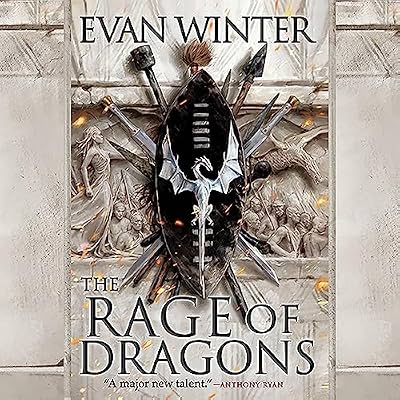
The Rage of Dragons
Best for a lean, propulsive epic off the usual trail.
Why it matches: A magical war and a hero who weaponizes the rules to climb it, in a world the Sanderson also-bought trail never points you toward.
The one the standard algorithms rarely surface for a Stormlight listener. Evan Winter builds a rigid, hyper-violent caste society locked in an endless war, drops in a protagonist who weaponizes the rules of combat to survive, and roots the entire epic in a brilliant, Xhosa-inspired world. It moves significantly faster than The Way of Kings, serving as the pure sprint on this list while offering a genuine break from Eurocentric fantasy settings.
Prentice Onayemi narrates with a rhythmic, almost percussive cadence that mirrors the book's military drills and war chants. He delivers the world's non-Western nomenclature with an innate, organic authority that makes the setting feel deeply lived-in rather than looked-up.

Shōgun (Part One)
Best for total immersion, with history instead of magic.
The smart edge, and the one that contains zero magic. James Clavell's historical masterpiece drops an English navigator into feudal Japan. What follows is an act of worldbuilding as absolute and complete as anything in high fantasy: a foreign culture rendered so thoroughly that you gradually learn to think inside its rules of power, politics, and honor. If what you truly loved about Roshar was the total immersion into a fully realized society with its own rigid codes, Shōgun delivers that scale perfectly. It just uses history instead of sorcery.
Ralph Lister voices the full historical sweep, from gruff European sailors to calculating samurai lords, holding distinct cultural registers apart without a hint of caricature. One production note: this is sold in two parts, and Part One alone runs over 24 hours, so it is a serious commitment even by Sanderson standards.
About the narrators
Michael Kramer, Kate Reading, and the invisibility trick
Michael Kramer & Kate Reading
Stormlight's anchor voices · the sound of modern epic fantasy
Kramer and Reading have been the paired voice of doorstop epic fantasy for decades, splitting The Wheel of Time and the vast majority of Sanderson's Cosmere between them. Their great gift is invisibility: they disappear into the prose instead of performing over it. On a book like The Way of Kings, that discipline is the entire reason the world feels real on audio. They read a Windrunner's gravitational lashings or a spren's sudden arrival as plain, unvarnished fact, never as exaggerated spectacle, and by keeping their delivery grounded they let Sanderson's internal rules carry the actual awe. It is no accident that two of the anchors on this list lean directly on Kramer. Every book here was selected with that exact vocal restraint as the reference point.
Adjacent shelves
If The Way of Kings is the starting point
Where Roshar's listeners tend to cross over next.
Frequently asked questions
FAQ: Audiobooks Like The Way of Kings
What audiobook is most like The Way of Kings?
The Eye of the World is the closest match. Beyond its massive epic scope, it features the exact same narration duo of Michael Kramer and Kate Reading, meaning the voices that guided you through Roshar carry you seamlessly into The Wheel of Time. There is a second edition of it worth knowing about, covered below.
Should I listen to the Rosamund Pike or the Michael Kramer version of The Eye of the World?
Both are excellent, and the honest answer depends on what you are optimizing for. Pike's 2021 recording won a 2023 Audie for Best Female Narrator, runs about three hours longer at a slower, more deliberate pace, and has noticeably crisper sound than the 2004 original. But Pike has only recorded the first four books, while Kramer and Reading carry all fourteen. If you are coming straight from The Way of Kings, start with Kramer and Reading: you keep the Stormlight voice, and you never have to switch narrators mid-series.
Are there other audiobooks here narrated by Michael Kramer?
Yes. Beyond The Wheel of Time, James Islington's The Shadow of What Was Lost features Kramer performing entirely solo. Because Islington writes with a highly structured, Sanderson-style magic system, it feels immediately familiar to a Stormlight listener.
Which books feature hard, rule-based magic systems like Stormlight's?
Look to The Black Prism, where magic is bound to the physics of light, Promise of Blood, a flintlock system built on gunpowder, and The Shadow of What Was Lost, which runs on an engineered magic with strict costs.
Why is Shōgun included on a fantasy recommendation list?
Because historical fiction at this scale requires the exact same psychological buy-in as epic fantasy. Clavell constructs feudal Japan with such intricate attention to political maneuvering, honor systems, and cultural rules that it scratches the precise itch left behind by Roshar's deep worldbuilding, swapping magic for real history.
New to Audible? Start your free 30-day trial →
How we picked
Selection criteria
Every candidate was scored and vetted before making the final cut. The question driving each pick was whether the recording would satisfy a listener who finished The Way of Kings and immediately wanted another deep world to inhabit. Because narration quality is paramount to an audiobook's success, same-scope fantasy novels with weak or overly dramatic performances were disqualified. That is why A Game of Thrones is absent: Roy Dotrice's polarizing, character-drifting performance fails the bar the seed sets. Picks one through three are the closest to the Stormlight experience, and picks four through eight are strong on scope or narration with some variation in tone and vintage.
Two notes on composition. Tone and era vary on purpose: The Blade Itself runs grimmer than Sanderson, and The Dragonbone Chair is an older, slower classic that rewards patience. The final pick, Shōgun, is historical fiction rather than fantasy, kept because its total-immersion worldbuilding scratches the exact nerve Stormlight does, only with feudal Japan in place of a magic system. Where a recording diverges from the seed, the pick copy says so plainly rather than hiding it.