Fantasy
Audiobooks Like The Name of the Wind

If Nick Podehl's Kvothe, a legend telling his own story with the patience to let every sentence land, is what kept you listening, this list starts there.
What makes The Name of the Wind work: prose that treats each sentence as an event, a slow, melancholic pace that rewards patience over plot, and a frame narrator telling his own legend, grief carried underneath the bravado. Every pick on this list shares at least one.
All 10 picks at a glance
| # | Title | Author | Narrator | Runtime | Listen |
|---|---|---|---|---|---|
| 1 | Jonathan Strange & Mr Norrell | Susanna Clarke | Richard Armitage | 36h 14m | Listen → |
| 2 | The Night Circus | Erin Morgenstern | Jim Dale | 13h 40m | Listen → |
| 3 | The Fifth Season | N.K. Jemisin | Robin Miles | 15h 27m | Listen → |
| 4 | The Bear and the Nightingale | Katherine Arden | Kathleen Gati | 11h 48m | Listen → |
| 5 | Assassin's Apprentice | Robin Hobb | Paul Boehmer | 17h 18m | Listen → |
| 6 | Tigana | Guy Gavriel Kay | Simon Vance | 24h 51m | Listen → |
| 7 | Red Sister | Mark Lawrence | Heather O'Neill | 19h 21m | Listen → |
| 8 | The Way of Kings | Brandon Sanderson | Michael Kramer, Kate Reading | 45h 30m | Listen → |
| 9 | The Shadow of the Wind | Carlos Ruiz Zafón | Jonathan Davis | 18h 5m | Listen → |
| 10 | The Book Thief | Markus Zusak | Allan Corduner | 13h 56m | Listen → |
What Name of the Wind listeners come back for
Nick Podehl's Name of the Wind is one of the few cases where the narrator became as famous as the book. His Kvothe, young, brilliant, unbearably self-aware, draws you in through the same mechanism as the frame device itself: a legend telling his own story to a scribe who may or may not believe all of it. The patience of Podehl's performance is what makes it work. Nothing is rushed. Every sentence lands before the next one begins.
Every pick below shares one or more of the things that make Name of the Wind an experience rather than just a story: prose that treats each sentence as an event, a world built with enough care that existing inside it is the point, or a narrator who earns the slow pace rather than just enduring it. The list runs from closest match to most deliberate departure. The last two picks cross into literary and historical fiction, and they're here because the listening experience lands closer to Rothfuss than most of the fantasy above them.
The picks · 1–10
Ten, ranked by how close they get to The Name of the Wind.
Order reflects how closely each recording delivers the Name of the Wind experience, with narration weighted highest in the scoring model.

Jonathan Strange & Mr Norrell
Best for listeners who want magic treated as a serious intellectual discipline, at full scholarly length.
The most structurally and tonally aligned fantasy novel to The Name of the Wind. Both books are about the rediscovery of magic as a serious intellectual discipline: Norrell's Yorkshire library of lost magical texts and Kvothe's University library of forbidden knowledge occupy the same imaginative space. Both are slow, both are literary, and both are deeply interested in what happens to exceptional minds when they encounter power the establishment wants to contain.
Clarke's novel is longer, drier, and funnier, and its elaborate scholarly footnotes are a feature, not a bug, but the underlying experience is the same: you are inside a world where magic is real and treated with the seriousness of an academic subject, and the pace refuses to hurry. Two editions exist. Richard Armitage's 2024 recording is the one most listeners encounter first, and the one linked here. Simon Prebble's earlier recording is also excellent and worth seeking out if you want to compare.
Armitage brings a gravity and physical presence to the reading that suits Clarke's Napoleonic-era register, and his Strange in particular carries the recklessness of a man who genuinely believes he can master anything. The footnotes, which threaten to derail the audiobook entirely, become audible marginalia in his hands rather than interruptions. Rated 4.9 for performance on Audible.
The Night Circus
Best for listeners who loved NotW's texture-over-pace spell and want the closest tonal match on the list.
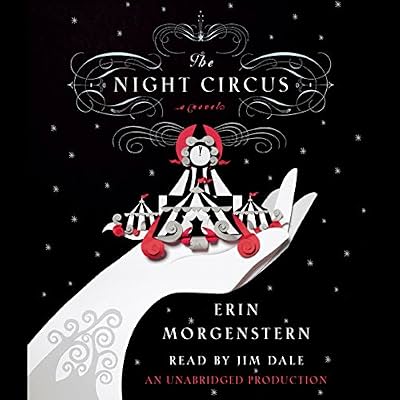
The closest tonal match here. Where The Name of the Wind is interested in how power is acquired, The Night Circus is interested in how power is expressed: the two young magicians' competition plays out entirely through beauty rather than violence, and Morgenstern's prose shares Rothfuss's investment in texture over pace. Both books are more interested in the feeling of being inside a story than in what happens at the end.
The circus arrives without warning, open only at night. The audience sees only illusions, impossibilities, marvels. What they don't see is the contest being waged inside it, or that the two magicians competing don't know the rules, or the cost.
Jim Dale approaches the circus the way a child approaches a fairy tale, his cadence slowed to match Morgenstern's unhurried prose rhythm. He doesn't narrate a fantasy novel; he tells a story that happens to be magical. The difference is audible from the first paragraph.
The Fifth Season
Best for listeners who want NotW's magic-as-discipline and sentence-level craft, and can take a much rawer emotional register.
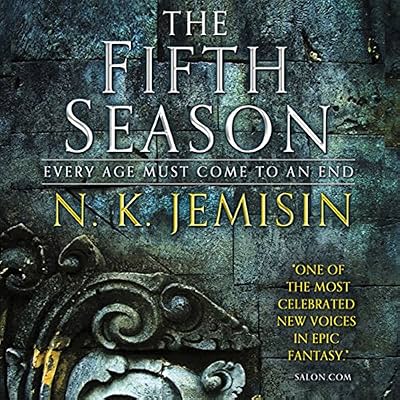
One honest caveat up front: The Name of the Wind stays melancholic throughout, but The Fifth Season becomes something rawer, politically devastating in ways Rothfuss never approaches. Jemisin earns every bit of it, but if you came for lyrical escape, this book will not stay escapist.
The connections are structural and tonal: magic as a discipline the powerful want to control, a protagonist whose exceptional abilities make her a target, and prose that treats its sentences as events rather than vehicles for plot. Jemisin's world-building is as meticulous as Rothfuss's, and the same sense of something enormous just out of reach governs both books. The Fifth Season won the Hugo Award three years running, three consecutive novels in a single series. That does not happen. The writing is the reason.
Robin Miles handles Jemisin's second-person present-tense sections, a narrative device that could feel like a stunt, with such complete conviction that the technique becomes invisible. The sections that could have broken the audiobook are the ones listeners remember longest.

The Bear and the Nightingale
Best for listeners who want the lyrical, melancholic, slow-burn atmosphere in a Russian-folklore key.
The closest structural match to NotW on this list. Both books use retrospective narration, a story told backward from legend toward origin, and both are driven by exploration and the emotional weight of relationships rather than plot mechanics. Where Rothfuss builds his world out of scholarship and music, Arden builds hers out of Russian folklore and long winters. The lyrical, melancholic, slow-burn atmosphere is a genuine tonal twin.
Vasya is the daughter of a nobleman at the edge of the Russian wilderness who can see the household spirits her family is supposed to have abandoned for Christianity. The old magic and the new faith are in collision, and Vasya is at the center of it.
Gati narrates as if she is the old nursemaid telling stories by firelight. AudioFile called it fireside storytelling on a crackling cold night, and that is the exact register the material requires: measured, atmospheric, unhurried, a narrator who understands that the voice is part of the world being built.

Assassin's Apprentice
Best for listeners who came for Kvothe's inward, grieving voice and want its closest tonal twin.
The closest tonal twin on this list. Robin Hobb's Farseer Trilogy opens with Fitz, an illegitimate royal bastard, trained as an assassin in a court that has already decided what he is worth. Single POV, retrospective narration, introspective slow pace, a deep melancholic register. Hobb's Fitz and Rothfuss's Kvothe are both prisoners of their own extraordinary abilities, and both are telling their stories from a position of loss.
Where Kvothe's tragedy is implied by the frame device, Fitz's tragedy is continuous. Hobb does not protect her characters. The emotional weight comes from accumulation, decades of it, which is why the series rewards listeners who stay.
Boehmer's understated delivery suits Fitz's quiet, inward voice. He doesn't oversell the tragedy: no telegraphing, no swelling emphasis on the moments that will matter later. The restraint is precisely right for a narrator who is trying to tell a story he still hasn't finished grieving.

Tigana
Best for listeners who want the most literary fantasy on the list, built entirely around loss and memory.
Guy Gavriel Kay's fantasy is the most literary on this list, closer to literary historical fiction than genre fantasy, and Tigana is his most emotionally devastating work. A province's name has been erased by a conquering tyrant using magic: the people born there cannot speak it to anyone who was not. Memory itself has been weaponized. The magic system is elegiac and melancholic by design, and loss is the novel's subject in a way that goes deeper than plot.
Like NotW, Tigana is a book about the weight of legend, about what it costs to carry a story that only you know is true. The prose is elevated, slow, and entirely committed to emotional precision over narrative pace.
Vance's ability to inhabit Kay's elegiac, measured register without making it feel theatrical is what separates this from a lesser performance. He treats the emotional weight of the novel with the same seriousness Kay does: no shortcuts, no moments of camp, no rushing where the prose asks for patience.

Red Sister
Best for listeners who want NotW's magic-academy architecture with a darker, faster edge.
Know going in: Red Sister shares NotW's magic-academy setting but not its lyrical introspection. It runs darker and faster, and the atmosphere shifts toward violence and consequence after the opening. With that said, the scenario is the most precise structural match for NotW on this list: an underdog protagonist placed inside a brutal institutional hierarchy, mastering forbidden abilities, navigating a world that has already written the story of who she is.
Nona Grey is eight years old, falsely accused of murder, rescued from the gallows by an abbess who sees something in her, and deposited inside a convent school where the curriculum includes assassination. Lawrence builds his magic academy with the same architectural care Rothfuss brings to the University, and the politics of who gets to learn what, and why, are present in both.
O'Neill was a 2018 Audie Award finalist for Best Fantasy Narration for this recording. Her Nona is quiet and dangerous rather than loudly heroic, and she differentiates every novice by age and manner without making a production of it. AudioFile praised her specifically for doing justice to Lawrence's lyrical prose.

The Way of Kings
Best for listeners who finished NotW wanting more world: more magic theory, more politics, more sheer size.
The obvious recommendation that earns its place but needs honest framing. Where Rothfuss is interested in interiority, Sanderson is interested in systems; where Rothfuss's pacing is meditative, Sanderson's is propulsive and architecturally ambitious. The melancholic register of NotW is absent here. This world is built for a different kind of listener: one who wants epic scale and world-building investment without the slow, lyrical atmosphere.
If you finished NotW wanting more of Kvothe, you might find the Stormlight characters feel less textured. If you finished it wanting more of the world, more magic theory, more politics, more sheer size, this is the pick.
Michael Kramer and Kate Reading divide the Stormlight Archive along gender-POV lines and hold that consistency across thousands of hours in this world. Their character differentiation across an enormous cast, keeping the same voices stable across five novels, is one of the great collaborative achievements in audiobook production. The narration is the reason people stay for 45 hours.

The Shadow of the Wind
Best for listeners who loved NotW's atmosphere more than its genre and will follow that spell somewhere unexpected.
This is literary fiction set in 1940s Barcelona, not fantasy. It belongs on this list because the listening experience is closer to The Name of the Wind than half the fantasy above it. A young boy discovers a mysterious author in a secret library called the Cemetery of Forgotten Books, and learns that someone is systematically destroying every copy of the author's work that exists. The mystery unspools across decades, governed throughout by a single obsession: the power of stories and the people who are shaped by them.
Both Zafón and Rothfuss write books that are about what it feels like to be inside a story. The frame structure, retrospective narration, single POV, lyrical melancholic prose, and exploration-as-engine are exact structural matches. This is the pick for listeners who loved NotW's atmosphere more than its genre.
Davis brings the Barcelona setting to life with a warmth that keeps the gothic atmosphere from tipping into melodrama. The performance has the quality of a story told late at night by someone who has lived inside it for a long time: unhurried, precise, haunted.

The Book Thief
Best for listeners who loved the frame device most: an all-knowing narrator telling a story whose ending is already grief.
Death narrates its own omniscient account of a young girl who steals books during World War II. This is the only title on this list where the frame device, an immortal narrator telling a human story from the outside, knowing how it ends before it begins, is structurally closest to Kvothe telling Chronicler his own legend. Both books use that distance to generate a specific kind of pre-emptive grief: the tragedy is known before it arrives. Both ask you to love characters they've already told you that you'll lose.
It is historical fiction, not fantasy. But no fantasy novel on this list handles the weight of a frame narrator, the sense of a story already finished being told by someone who survived it, as precisely as this one does.
Corduner's Death is philosophical and restrained. He earns the performance's weight without making the narration maudlin, and the restraint is the performance. A narrator who oversold Death's omniscience would ruin the book; Corduner treats it as a burden, which is what Zusak intended.
About the narrator
Nick Podehl and the voice of The Name of the Wind
Nick Podehl
NotW's anchor voice · the performance that made the book an audiobook phenomenon
Nick Podehl has narrated over 200 audiobooks, but The Kingkiller Chronicle is the performance he is most identified with, and for good reason. His Kvothe is not a performance in the theatrical sense; it is a sustained act of inhabitation. The voice Podehl builds for Kvothe at fifteen, at twenty, and at the inn are three registers of the same person, aging in real time across thousands of pages. The pause before a difficult sentence. The way a brag can carry grief underneath it. This is the performance that made NotW an audiobook phenomenon rather than simply a good fantasy novel, and it is the standard against which every pick on this list was measured.
Adjacent shelves
If The Name of the Wind is the starting point
The shelves lyrical-fantasy listeners cross over to most often.
Frequently asked questions
FAQ: Audiobooks Like The Name of the Wind
What audiobook is most like The Name of the Wind?
Jonathan Strange & Mr Norrell (narrated by Richard Armitage) holds our #1 spot: it's the closest fantasy to NotW on the magic-as-serious-discipline axis, slow and literary and interested in what happens to exceptional minds. For the closest tonal twin instead, Assassin's Apprentice (Paul Boehmer) matches Kvothe's inward, grieving, retrospective voice almost exactly.
Which pick is closest to Nick Podehl's narration style?
Look for the unhurried, storyteller-first performances that let each sentence land. The Bear and the Nightingale (Kathleen Gati) reads like fireside storytelling, and The Night Circus (Jim Dale) slows its cadence to match the prose rather than driving the plot. Both prize atmosphere the way Podehl does.
Are any of these as slow and lyrical as NotW, or do they pick up the pace?
Most match the slow, lyrical register on purpose. The two that shift are flagged in the copy: The Fifth Season turns rawer and more politically devastating, and Red Sister runs darker and faster after its opening. The Way of Kings trades melancholy for propulsive epic scale. Everything else stays in NotW's unhurried lane.
Why are literary and historical fiction on a fantasy list?
Because the listening experience is closer to NotW than the genre label suggests. The Shadow of the Wind and The Book Thief both run on the exact frame-narrator, retrospective, story-about-stories machinery that makes NotW work. They're the discovery picks: chosen for the experience, not the shelf.
New to Audible? Start your free 30-day trial →
How we picked
Selection criteria
We listened to each candidate before deciding. The question driving every pick was whether the recording would satisfy the listener who finished The Name of the Wind and wanted to stay in that register. Narration quality was weighted highest in the scoring model. Same-genre matches without a performance that earns the slow pace were cut. Picks 1 through 3 are the closest matches to the seed and rank highest in the default profile; picks 4 through 8 vary in tone and scale while holding the lyrical or structural connection.
Picks 9 and 10, The Shadow of the Wind and The Book Thief, are the discovery picks: literary and historical fiction the algorithm would never surface for a fantasy reader, included because their frame-narrator machinery is a nearer match to NotW than most of the fantasy on the list. They broaden the listening map without breaking the cluster.